
Introduction to the New Paradigm of Space Exploration
On April 24, 2026, during the opening ceremony of the eleventh Space Day of China held in the metropolis of Chengdu, capital of Sichuan province, the China National Space Administration (CNSA) made an official announcement that irreversibly reconfigures the landscape of global interplanetary exploration. In a historical moment characterized by profound programmatic uncertainty and budgetary pressures for Western space powers, the Chinese space agency detailed the final results of its international collaboration selection for the Tianwen-3 mission. This project constitutes the most ambitious national campaign ever conceived by the Asian giant, destined not only for robotic exploration but for the collection, launch from an alien gravity well, and safe return of Martian samples to Earth.
The timeline established by the CNSA, categorically reaffirmed by program directors, targets the year 2028 for the launch of the complex mission architecture and the year 2031 for the effective return of geological samples to the terrestrial biosphere. This planning does not merely represent an unprecedented engineering challenge in the history of the Chinese space program; it constitutes a masterfully calculated geopolitical maneuver to position Beijing as the undisputed leader in deep space science. By opening a 20-kilogram payload capacity to the international scientific community—strictly distributed as 15 kilograms for the interplanetary orbiter and 5 kilograms for the service module—China has managed to attract 28 highly advanced technological proposals from global institutions.
Guan Feng, director of the CNSA's Lunar Exploration and Space Engineering Center, confirmed to the international community that the mission has surpassed preliminary design phases and officially entered the physical prototype development phase. From the multiple applications evaluated, five projects were selected under rigorous criteria: high intrinsic scientific value, effective and demonstrable support to the primary mission, engineering viability under extreme conditions, and a technological maturity that guarantees success.
This exhaustive investigative report breaks down and analyzes the technical architecture of the Tianwen-3 mission, evaluates the strategic dissonance with concurrent Western programs, delves into the physical and spectroscopic capabilities of the five selected international payloads, and projects the second and third-order implications this milestone imposes on astrobiology, technological diplomacy, and the balance of geopolitical power in the solar system's orbit.
The Crisis of Western Architecture and China's Window of Opportunity
To understand the magnitude of the announcement made in Chengdu, it is imperative to contextualize the contemporary space scenario. The CNSA's decision to integrate instruments from the University of Hong Kong, the Chinese University of Hong Kong, the Macau University of Science and Technology, the National Institute for Nuclear Physics of Italy (INFN), and the Committee on Space Research (COSPAR) goes far beyond standard academic collaboration. It represents a strategy of dual projection: the exercise of soft power through inclusive scientific diplomacy and the assertion of hard power through the demonstration of autonomous, cutting-edge engineering capabilities.
The Logistical Labyrinth of NASA and ESA's Mars Sample Return (MSR)
The announcement of the Tianwen-3 mission comes at a time of structural vulnerability for its Western equivalent. Historically, the Mars Sample Return (MSR), co-led by NASA and the European Space Agency (ESA), has been considered the Holy Grail of planetary science. However, the MSR architecture has recently faced severe budgetary reviews, emergency design re-evaluations, and threats of cancellation stemming from a mission model that has become financially unsustainable and mechanically overcomplicated.
Interestingly, the American program opted for a highly decentralized collection paradigm. This strategy initially relied on the Perseverance rover, a machine of astonishing geological sophistication that has spent years traversing Jezero Crater, identifying, drilling, and encapsulating lithological samples from an ancient lakebed and river delta. The complexity lies in retrieving these titanium tubes scattered across the surface. The original plan required the future dispatch of a lander carrying a Mars Ascent Vehicle (MAV) and a Fetch Rover or a fleet of cargo helicopters to collect the tubes, transport them to the MAV, launch them into Martian orbit, and wait for an Earth Return Orbiter (ERO) supplied by ESA to capture them for their journey home.
The accumulation of single points of failure in this sequential chain of events, coupled with proposed cuts in the 2026 Discretionary Funding Request in the United States, has caused the Western timeline to dilate significantly, drifting away from viability in the early 2030s.
Capitalizing on Uncertainty
China has methodically observed and capitalized on this programmatic volatility. By offering certainty in execution timelines and guaranteed physical access to the Martian orbit and surface to top-tier institutions, the CNSA has established itself as a predictable and highly capable actor. The inclusion in the Tianwen-3 mission of European laboratories, such as the Frascati National Laboratory under the umbrella of Italian nuclear physics, and the COSPAR exploration panel—an international organization with deep roots in the French and European research ecosystem—evidences a tactical fracture in the monopoly traditionally held by Washington-led missions.
Despite growing geopolitical frictions and technological export control regimes on Earth, the scientific imperative to access unprecedented data on Martian habitability and the possibility of co-signing the first discovery of extraterrestrial life have overcome diplomatic barriers. Guan Feng emphasized that some international partners are already delivering operational prototypes for vacuum and thermal stress testing in Chinese facilities, proving that cooperation is not a mere declaration of intent, but a tangible hardware reality.
The Grab and Go Paradigm: Operational Simplicity vs. Geological Diversity
The projected success of Tianwen-3 is built on a space engineering design philosophy radically opposed to that of the Western MSR. The Chinese architectural approach prioritizes the mathematical probability of short-term mission success through the relentless reduction of critical variables, adopting a strategy known in systems engineering jargon as grab and go.
Surface Risks and the Time Equation
In the hostile environment of Mars, the variable of time works against any terrestrial machinery. The accumulation of microscopic and electrostatic dust on solar panels and moving mechanisms, brutal diurnal thermal oscillations that fatigue materials, high surface radiation, and telecommunications latency introduce enormous cumulative operational risks. Unlike NASA's paradigm, which seeks maximum geological diversity through a multi-year traverse to accumulate strata from different eras, Tianwen-3 will be executed with the urgency of a tactical raid.
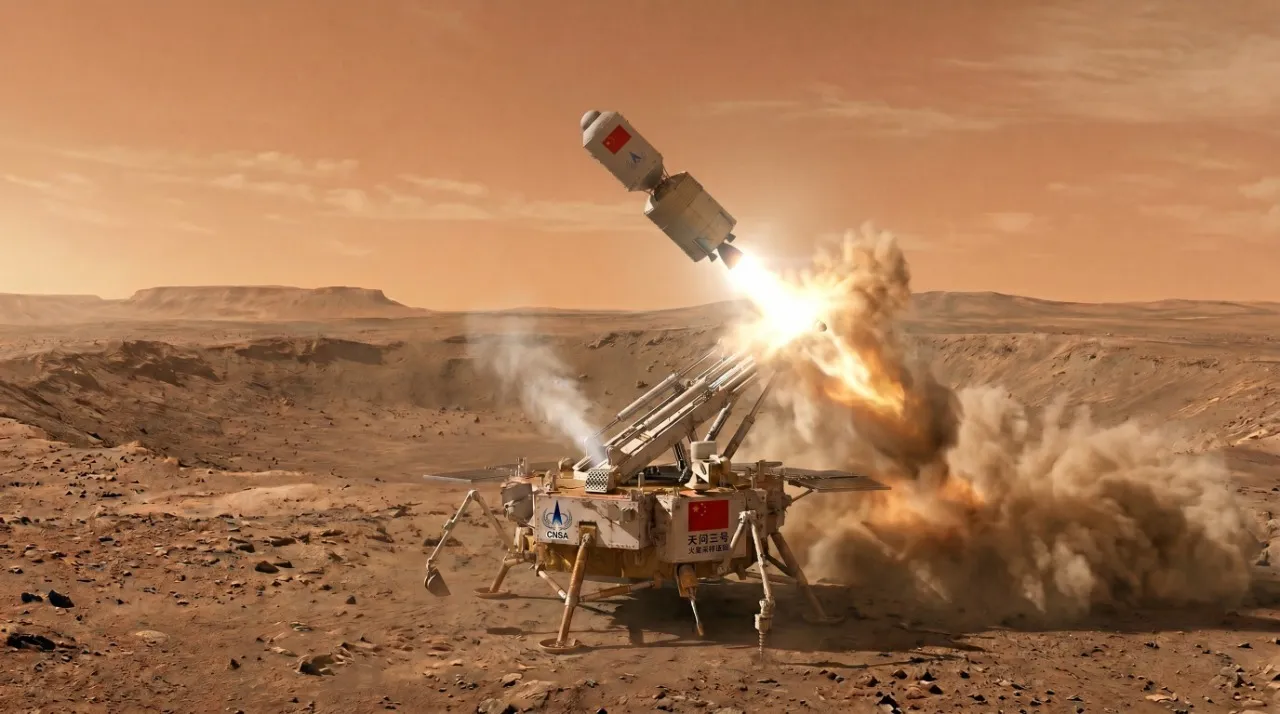
The Chinese mission will land at a singular site, geologically pre-selected for its high scientific potential—possibly basins that once held water or mineralogical transition zones. Once on the surface, the module will not deploy a long-range rover. Instead, it will use integrated mechanical systems, likely robotic arms with surface regolith collection scoops and rotary percussion drills for early subsurface sampling, to extract material in a static, concentrated radius. After collecting at least 500 grams of soil and rocks, the material will be encapsulated and immediately transferred to the ascent vehicle.
The Scientific Trade-off
It is undeniable that the rapid raid strategy offers a narrower scientific return in terms of stratigraphic context, as it lacks the temporal and spatial breadth provided by a deep exploration rover. As planetary science analysts point out, a randomly collected sample may be insufficient to answer absolute questions about hydro-cryosphere evolution and the total chronological timeline of Mars.
However, from the perspective of aerospace engineering risk management, its simplicity drastically increases viability within a compressed timeframe. By eliminating the need for multiple independent spacecraft to land near each other over several years and for autonomous rovers to transfer small tubes from one vehicle to another in an environment full of rocks and loose sand, the Chinese architecture narrows the margins of mechanical error. To mitigate the lack of physical geological diversity, Tianwen-3 will employ state-of-the-art remote sensing instruments in orbit to characterize the global environment, contextualizing the isolated sample within the planet's overall map.
Mission Architecture: A Systems Engineering Challenge
To materialize the return of Martian samples, physics dictates massive Delta-V—change in velocity—requirements. Energy is needed to escape Earth's gravity, perform the interplanetary transit, brake to enter Martian orbit, descend to the surface, accelerate again to reach Mars orbit from its surface, inject into an Earth-return trajectory, and finally survive atmospheric reentry.
No existing rocket can launch a single spacecraft with all the necessary pre-assembled stages for this complete cycle. Therefore, the CNSA has fragmented the Tianwen-3 mission architecture into five main modular components, which will require an independent launch profile using two super-heavy lift vehicles.
The Five Modular Pillars of Tianwen-3
The first component is the Lander. This highly structural-resistant platform is in charge of the critical Entry, Descent, and Landing phase. The module must absorb the thermal loads of hypersonic braking in the thin Martian atmosphere, deploy supersonic parachutes, and utilize retrorockets for a soft touchdown. Housing in situ laboratories, mechanical arms, and drilling systems, it constitutes the core of the mission's physical collection.
Physically integrated on top of the lander is the Ascent Vehicle. This autonomous rocket is the mission's single highest-risk element. Its sole and vital function is to ignite its thrusters in the Martian environment—a milestone never achieved by any agency—overcome the local gravity well, and deliver the sample container into a predetermined low Mars orbit.
Operating in deep space, the Service Module provides main propulsion, attitude control systems, telecommunications, and power generation via solar panels during the outbound and return transits. Furthermore, it acts as a stabilized mounting platform for various hyperspectral observation payloads.
The long-term brain of the mission is the Orbiter. Upon reaching Mars, it will execute aerobraking maneuvers to establish a stable orbit. Its mission bifurcates: conducting systematic spectroscopic and atmospheric soundings of the planet, and orchestrating the complex orbital rendezvous with the Ascent Vehicle to transfer the sample container to the return module.
Finally, the Return Module consists of a conical structure, coated with advanced ablative materials, designed exclusively to protect the sample container during the final interplanetary transit and survive the temperatures of thousands of degrees Celsius generated by friction during ballistic reentry into Earth's atmosphere at speeds exceeding 11 kilometers per second.
The Propulsive Muscle: Double Launch of the Long March 5
To place this infrastructure on trans-Martian routes, China will rely on the heavy-lift variant of its Long March 5 rocket, affectionately known as the Fat Five due to its 5-meter diameter core. Launched from the Wenchang Spacecraft Launch Site at low latitude in Hainan province, these vectors represent the technological pinnacle of the China Academy of Launch Vehicle Technology.
The Long March 5 is the first Chinese launch vehicle to abandon toxic hypergolic propellants in favor of cryogenic liquid propellants, offering vastly superior specific impulse, capable of injecting more than 8,800 kilograms directly into interplanetary transfer trajectories. Although mathematical reliability models indicate that cryogenic propulsion and control systems in new heavy rockets face steep learning curves in their initial flights, the record of sustained successful launches of the CZ-5 and its variants during 2024 and 2025 demonstrates a system maturity that justifies confidence in a dual launch with such strict Martian transfer windows.
The Operational Bottleneck: Rendezvous and Docking in Mars Orbit
While ascending from the Martian surface is complex, the true technical challenge lies in the orbital rendezvous and docking around Mars. Unlike similar operations routinely performed at the International Space Station or in lunar orbit with the Chang'e missions, the Earth-Mars distance imposes a light-speed communication delay ranging from 4 to 24 minutes.
This signal delay makes any type of real-time human telemetric piloting impossible. When the Ascent Vehicle reaches its orbit, the Orbiter must locate it, calculate its relative spatial ephemerides, match its velocity, and align its vectors to perform a mechanical docking using exclusively onboard machine vision systems, autonomous computational logic, and embedded artificial intelligence. A miscalculation of fractions of a second would result in an orbital collision or the loss of the container in deep space.
Deep Analysis of International Payloads
The heavy architecture of Chinese engineering will be complemented by international analytical precision. In April 2025, the announcement of opportunity issued by the CNSA offered a highly restricted mass quota: 20 kilograms total. Out of 28 submitted proposals, the scientific committee selected five comprehensive projects that provide perfect synergy with the mission's philosophy, structuring an analytical matrix that spans from the exosphere to the surface.
1. Mars PEX Spectrometer (Led by COSPAR)
Housed on the orbiter, the Mars PEX Spectrometer will act as the primary mineralogical reconnaissance tool on a planetary scale. Developed by a consortium of researchers under the direction of the Committee on Space Research's Exploration Panel—an entity with strong institutional anchoring in France and Europe—this instrument is calibrated to scrutinize the spectral absorption signatures of light reflected off the surface.
The PEX's scientific mandate is the direct search for biosignatures and detailed analysis of global mineralogical composition. The inclusion of this payload is a masterstroke of scientific diplomacy. Faced with technological restrictions imposed by Western geopolitics, European scientists have found in Tianwen-3 a legitimate avenue to participate in sample return. Scientifically, the data generated by PEX will provide the indispensable macro context, allowing terrestrial geologists to extrapolate the microscopic findings of the returned physical sample to other mineralogically analogous regions of the planet.
2. Molecular Ion Composition Analyzer (MUST)
Led by the Macau University of Science and Technology, this sophisticated mass spectrometer will address a fundamental question of planetary paleoclimatology: the reason why Mars lost the thick, protective atmosphere that once allowed rivers of liquid water to sculpt its surface.
The absence of a structured global magnetic field on Mars has left its atmosphere exposed to the relentless friction and drag of the solar wind over billions of years. The ion analyzer will monitor the high Martian exosphere in situ, measuring the directional flux of heavy molecular ions as they are accelerated to escape velocity. By precisely measuring the current rate of atmospheric bleed into space, astrophysicists will be able to project models backward into deep time, establishing the exact chronological window during which the Martian surface was warm and biologically viable.
3. Laser Heterodyne Spectrometer (LHS - CUHK)
The Chinese University of Hong Kong's contribution to the orbiter represents a quantum leap in remote sensing resolution. The Laser Heterodyne Spectrometer is a marvel of optical physics that operates under the principles of interferometry.
Heterodyne detection works by collecting light from the target and mixing it with a highly stable local laser beam generated aboard the spacecraft. This mixing produces an electromagnetic beat frequency that preserves all the spectral information in a range manageable by standard electronic processors. The instrument will probe the vertical profile of the Martian atmosphere to measure the distribution of water isotopes—specifically the ratio between Deuterium and Hydrogen—acting as an irrefutable water clock to calculate the original oceanic mass. Furthermore, it will achieve direct, three-dimensional measurement of Martian wind fields through microscopic analysis of Doppler broadening.
4. Terrestrial Hyperspectral Imaging Spectrometer (HKU)
Housed in the service module, this instrument from the University of Hong Kong integrates purely scientific objectives with operational survival imperatives. Using a Shortwave Infrared sensor, it fragments light into hundreds of narrow channels to assign a unique chemical signature to each pixel of terrain, identifying deposits that require prolonged liquid water for their formation.
Its most critical role occurs before geological collection. During the lander's descent, the imager will function as an early-warning weather radar, forecasting the emergence of dust storms from orbit. This guarantees that the Entry, Descent, and Landing sequence is executed under optimal aerodynamic and visibility conditions. Once the return phase is finalized, the service module will maintain its orbit for at least five years to continue observing low latitudes.
5. Laser Retroreflector Array-3 (INFN, Italy)
The only international component of Tianwen-3 that will make physical contact with the Martian surface will travel attached to the lander. Directed by Italy's Frascati National Laboratory, the Laser Retroreflector Array-3 is a passive optical device, devoid of electronic components or moving parts.
Consisting of a matrix of prisms that return any incident light beam in the exact parallel direction, this instrument solves the critical problem of orbital rendezvous. By firing laser pulses from the orbiter towards the surface, the bounced signal will allow establishing geodetic reference points of extremely high precision for the ascent vehicle's liftoff. In the long term, this device will remain on Mars in perpetuity, serving as a permanent topographical beacon for the navigation of future robotic and crewed infrastructure.
Institutional Synergies and Ground Segment Processing: The Role of Lab-DeepSpec
Bringing 500 grams of pristine Martian soil back to Earth represents the culmination of the flight effort, but only the beginning of the science. Anticipating the analytical demands this entails, China has not only curated the design in space but has fortified its terrestrial processing networks, orchestrating a profound synergy between the mainland and the Special Administrative Regions.
A paradigmatic example is the Joint Laboratory for Deep Space Matter Composition Spectroscopic Detection, known as Lab-DeepSpec, formalized in Anhui. This coalition demonstrates a mature innovation ecosystem: while universities in Hong Kong and Macau provide precision optics and theoretical models, mainland institutes transform blueprints into hardware qualified for the unforgiving vacuum of space. By ensuring that the entire lifecycle of the instrument resides within a national and regional coalition, Beijing guarantees its intellectual sovereignty and compliance with its 14th Five-Year Plan.
Second and Third-Order Implications for Global Space Leadership
The systematic advance of the Tianwen-3 mission architecture toward liftoff in 2028 detonates multiple macro-strategic implications. First, a profound restructuring of international collaboration networks; European participation demonstrates that the gravity of investigating Mars' primordial climate and finding prebiotic signatures transcends terrestrial geopolitical walls.
Second, the dynamization of peripheral scientific talent by massively integrating the Greater Bay Area into projects of absolute national prestige. Third, the establishment of a modular platform for prolonged interplanetary dominance, where the success of the Long March 5 rocket and autonomous docking techniques will pave the way for missions to the lunar south pole and the frigid Jovian system.
Finally, there is an undeniable disruption of anthropological and philosophical status. If Chinese laboratories are the first to analyze matter from an alien environment and potentially inform the world of the first physical evidence of past extraterrestrial life, they will cause a seismic shift in the narrative of civilizational leadership, eclipsing decades of Western prestige.
Final Reflection
The architecture, design, and diplomatic projection of the Tianwen-3 mission constitute a masterclass at the intersection of applied physics and geopolitical strategy. While the original scaffolding of the American and European Mars Sample Return grapples with the bureaucratic and mechanical complexity of an operation vulnerable to multiple points of failure, China has executed an impeccable tactical reduction toward the simplicity and reliability of a rapid raid.
By committing to the grab and go technique at a single site, the CNSA has managed to firmly maintain its schedule. To compensate for the limitation in the sampling spectrum, the integration of five highly advanced international payloads will create the perfect macroscopic data fabric. If success crowns this colossal engineering effort and the Return Module descends safely onto the steppe in 2031, the Tianwen-3 mission will have unquestionably forced the baton pass at the vanguard of global space leadership. It has been a pleasure to rigorously unpack these astropolitical and engineering milestones for you; space progress advances relentlessly, but it requires the infinite patience of those who understand that every gram of alien dust is a triumph of human persistence.
Related
Missions
- 🛰️ Opportunity
- 🛰️ Perseverance
Related news and articles
- 📰 The Rebirth of Rosalind Franklin: Geopolitics, Martian Drills, and the Search for Subsurface Life 26 NOV 2025
- 📰 Mars in May 2026: Technical and Geopolitical Reality 2 MAY 2026
- 📰 ExoMars and Parachute Sterilization: Technical Rigor to Avoid Contaminating Mars 1 MAY 2026
- 📰 Mars 2026: The Twilight of Traditional Agencies and the Dawn of Commercial Pragmatism 31 DEC 2025
Marspedia terms
Enjoyed it? Keep exploring
Back to all news