
The Financial Anatomy of Project Apex
The fundamental abyss that exists between the theoretical projections of aerospace logistical capabilities and the harsh operational reality weighs heavily on the contemporary space sector. At the end of April 2026, a confidential filing with the SEC revealed "Project Apex", the strategy by which SpaceX is pursuing an astronomical corporate valuation of $1.75 trillion ahead of its Nasdaq debut. The document unveils that the company has already invested over $15 billion in its Starship system, a figure that dwarfs the cost of the historic Falcon 9. To justify such a valuation, the market must perceive SpaceX not as a launch provider, but as a monopolistic conglomerate. The financial scrutiny, based on a sum-of-the-parts model, reveals an extreme reliance on projected revenues from divisions such as Starlink, the future Starship commercial network, or the artificial intelligence subsidiary xAI. Curiously, for the numbers to add up, investors must assume flawless technical execution with zero margin for error. It is like trying to sell a mansion at the price of a palace based solely on very promising architectural blueprints; a leap of faith that ignores the immense friction of real technological development.
Logistical Symbiosis and the Tyranny of Orbital Volume
This colossal capital injection into Starship is inextricably linked to the survival of Starlink. The third generation of satellites, the Starlink V3 hardware, introduces massive dimensions and weights ranging between 1,250 and 1,500 kilograms. These proportions make the new satellites physically intolerable for the volumetric payload fairing of the current Falcon 9. Deploying this new network using traditional rockets would be as inefficient as trying to fit a grand piano into the trunk of a compact car —a geometric impossibility that would suffocate the network's growth—. Consequently, the future of Starlink is mathematically unviable without the immense cargo bay of the Starship V3, capable of transporting up to a hundred of these giants per flight and enabling the creation of true solar-powered orbital data centers.
Clean-Sheet Architecture and the Raptor V3 Revolution
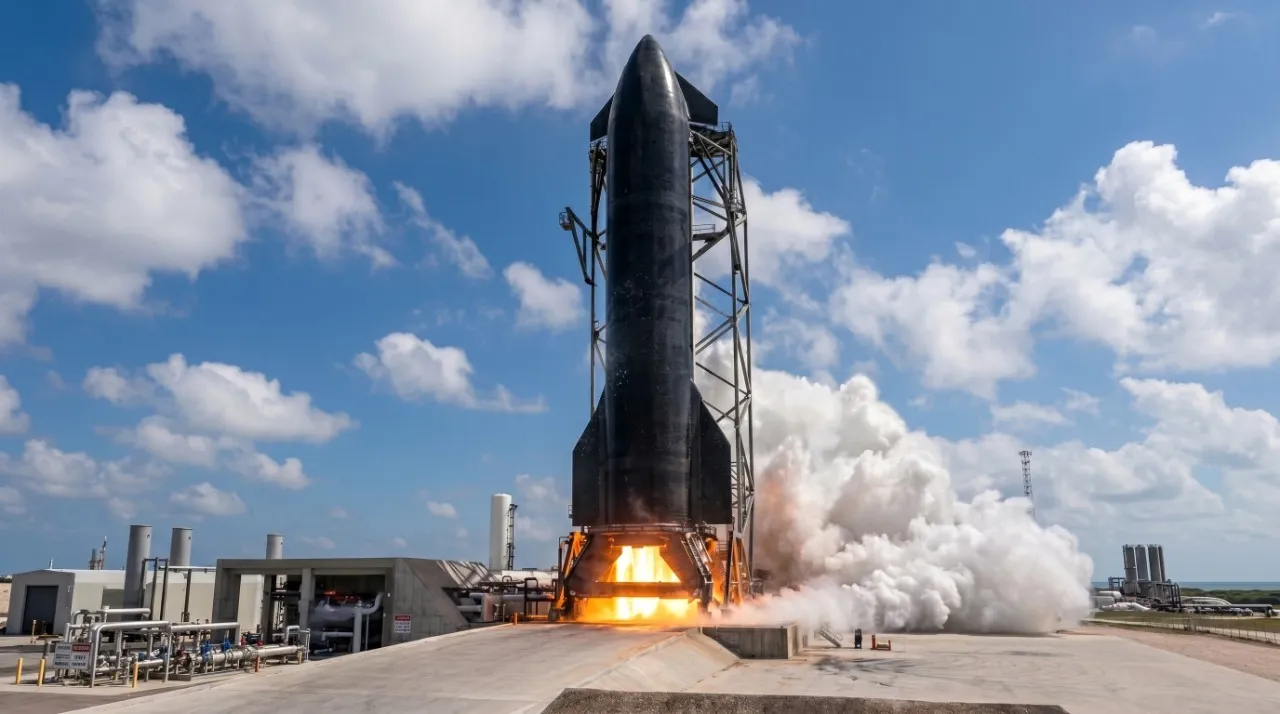
As an empirical response to the violent deflagrations suffered in previous tests, SpaceX has introduced a holistic redesign in its impending Flight 12. The V3 architecture systemically integrates all the engineering solutions developed retrospectively. At a structural level, the thermal geometry has been modified and the fuselage elongated to accommodate a larger quantity of liquid oxygen, optimizing the mass for combustion. But the true heart of this revolution lies in the Raptor V3 engines. Historically, high-performance engines suffered from the Christmas tree syndrome, riddled with external tubes and wiring vulnerable to vibrations. Through massive additive manufacturing techniques, engineers have printed the complex plumbing directly inside the solid structure of the engine block. By channeling the subcooled methane inside the walls to absorb heat, they have managed to eliminate the heavy external heat shields. This purge of dead mass works on the same principle as a modern internal radiator versus old and bulky external cooling systems —fewer parts mean fewer catastrophic failures and a higher thrust ratio—.
Terrestrial Bottlenecks and the Martian Postponement
However, the astonishing iterative dexterity in design clashes violently with an insurmountable glass ceiling: the physical limitations of ground infrastructures. The simultaneity of the 33 engines generates an energy that demands a million gallons of water per launch to prevent acoustics from destroying the rocket, a hydrodynamic stress that has collapsed sensors and damaged cascading engines. Progress is not a triumphant parade, but a bureaucratic, slow, and often explosive advance, as demonstrated by the recent catastrophe at the Massey facilities caused by a defective nitrogen valve. Faced with the immense unsolved challenge of transferring cryogenic fuels at -183 degrees Celsius in the vacuum of space without them evaporating, management has had to yield. Given the geopolitical pressure of China's advances and the push from rivals like Blue Origin, SpaceX has postponed its foundational dream of colonizing Mars by five to seven years. The imperative now is to secure the Artemis lunar program for NASA. At the end of the day, the conquest of space is not about grand declarations, but about taming, nut by nut and step by step, the unforgiving tyranny of the rocket equation. It has been a pleasure unraveling this exciting reality with you; see you in the next orbit.
Related
Related news and articles
- 📰 The Price of Forcing the Way to Mars: Lights and Shadows of Chun Wang's Interplanetary Plan with Starship 30 MAY 2026
- 📰 Flight 12's Pause: Anatomy of a Technical Delay and Today's Window 22 MAY 2026
- 📰 Starship Flight 12: The Maturity of Block 3 and the Heart of Raptor 3 21 MAY 2026
- 📄 The Mars Farming Challenge: Why Space Agriculture Is More Complex Than Science Fiction 25 JUL 2026
Enjoyed it? Keep exploring
Back to all news