
Deep space exploration is inescapably subordinated to the inflexible tyranny of orbital mechanics, a discipline governed by immutable laws that dictate the rhythms that both private megacorporations and government agencies must obey without exception. Every twenty-six months, the cosmic choreography between Earth and Mars produces a precise geometric alignment that opens an optimal transfer window. This window acts as an ephemeral gravitational corridor that allows interplanetary transit while maximizing energy and logistical efficiency. However, the launch window that opens at the end of this year 2026 represents a resounding historical anomaly and an unprecedented structural turning point in our quest to conquer the inner Solar System.
Historically, these time windows have been the stage where Western space powers deployed their most sophisticated rolling laboratories, a risk-averse paradigm that reached its maximum expression with the landing of the Perseverance rover in 2020. In a sharp contrast that defines our era, the scenario for 2026 stands out for the absolute desertion of American and European governmental landing missions. Classic agencies are trapped in a perfect storm of drastic budget cuts, severe logistical rethinking, and the deep geopolitical scars derived from terrestrial conflicts that have torpedoed collaborations forged over decades. This institutional vacuum—far from representing a setback—has catalyzed a radical metamorphosis, shifting the weight of exploration from state monoliths towards a much wilder and more pragmatic hybrid ecosystem.
The Non-Negotiable Physics of Interplanetary Travel
To understand the urgency and strategies of space actors in 2026, it is imperative to assimilate the underlying physics. All Mars missions use the Hohmann transfer orbit, an elliptical trajectory that uses the Sun's immense gravity well to do the heavy lifting. To understand this celestial mechanics concept, imagine trying to throw a dart at a target that is not only moving fast but is also traveling on a carousel concentric to yours; you do not aim where the target is now, but rather you throw the dart into the empty space where both will meet in the future, taking advantage of the momentum of your own spin so the dart arrives almost effortlessly. This maneuver minimizes the delta-v, meaning the required change in velocity, which directly translates into a colossal fuel saving and the possibility of carrying heavier scientific instruments.
The specific launch window opening between November and December 2026 offers a technical navigation route that, while essential, is energetically more demanding than the cycles immediately following. This trajectory will culminate in the Martian opposition of February 2027, at which point Earth and Mars will be separated by approximately one hundred and one million kilometers, as the encounter occurs near the Martian aphelion. This moderate distance necessitates a greater commitment of propellant and results in a communication latency of about six minutes; meanwhile, the reduced solar intensity during this orbital phase compels robotic explorers to optimize every watt to survive the extreme cold. Interestingly, this alignment is far less energetically favorable than those we will witness in the 2031 and 2033 cycles, which will allow for shorter and significantly more efficient trajectories.
The Western Collapse and the Rescue Mission
The most striking feature of this cycle is the retreat of NASA and the European Space Agency. The Mars Sample Return program, conceived as the pinnacle of astrobiology to bring back to Earth samples collected by Perseverance, has collapsed under its own bureaucratic and technical weight. The original design demanded an absurd choreography of multiple landers, contingency helicopters, and Martian ascent rockets, raising costs to an unsustainable eleven billion dollars. Faced with this financial hemorrhage, the US Congress decapitated the budget in 2026, reallocating barely one hundred and ten million for basic research. As a result, the thirty-three titanium tubes meticulously sealed with the most valuable regolith in the universe will remain stranded indefinitely in Jezero crater, waiting for the commercial sector to invent a cheaper interplanetary courier service.
Europe fares no better. The prodigious Rosalind Franklin rover of the ExoMars mission, designed to drill two meters deep in search of biosignatures away from sterilizing radiation, was left orphaned of a rocket and landing platform after the ESA severed relations with the Russian agency Roscosmos due to the conflict in Ukraine. Although NASA has come to the rescue by supplying radioisotope heaters and contracting a SpaceX Falcon Heavy rocket, the re-engineering has forced a massive delay. The Rosalind Franklin will not see the red dust of Oxia Planum until at least late 2030. Meanwhile, the West consoles its ego by focusing all its resources on the Artemis lunar program, prioritizing cislunar geopolitics over scientific advancement on Mars.
Japan's Asymmetric Dominance on the Martian Moons
Faced with this panorama of Western immobility, the Japan Aerospace Exploration Agency rises as the undisputed scientific vanguard of the decade with its bold MMX mission. Instead of fighting against the severe gravitational field of Mars, JAXA has targeted its enigmatic moons, Phobos and Deimos. The goal is to resolve once and for all whether these bodies are primordial asteroids captured by Martian gravity, or if they are the coalesced remains of an ancient cataclysmic impact. If the impact hypothesis is confirmed, MMX will succeed in bringing back to Earth fragments of the primordial mantle of early Mars, a monumental scientific milestone.
The MMX probe is a prodigy equipped with infrared spectrometers, ultra-high-resolution cameras, and gamma-ray meters. But its greatest challenge is collecting material on Phobos, a body with such minuscule gravity that the slightest mechanical push could bounce the four-ton spacecraft into deep space. To solve this, they have designed a pneumatic sampling system with no moving parts. Imagine trying to clean a dusty table by shooting a short, violent blast of compressed air through a straw and then catching the flying particles in a net; this is how MMX will inject high-pressure nitrogen gas to lift the Phobosian regolith and introduce it into the return capsule, which should land in Australia in 2031. Furthermore, the spacecraft will release IDEFIX, a hyper-light European micro-rover of barely twenty-three kilos that will navigate microgravity with mesh-shaped wheels, analyzing the surface centimeter by centimeter.
Commercial Brute Force: SpaceX's Gamble
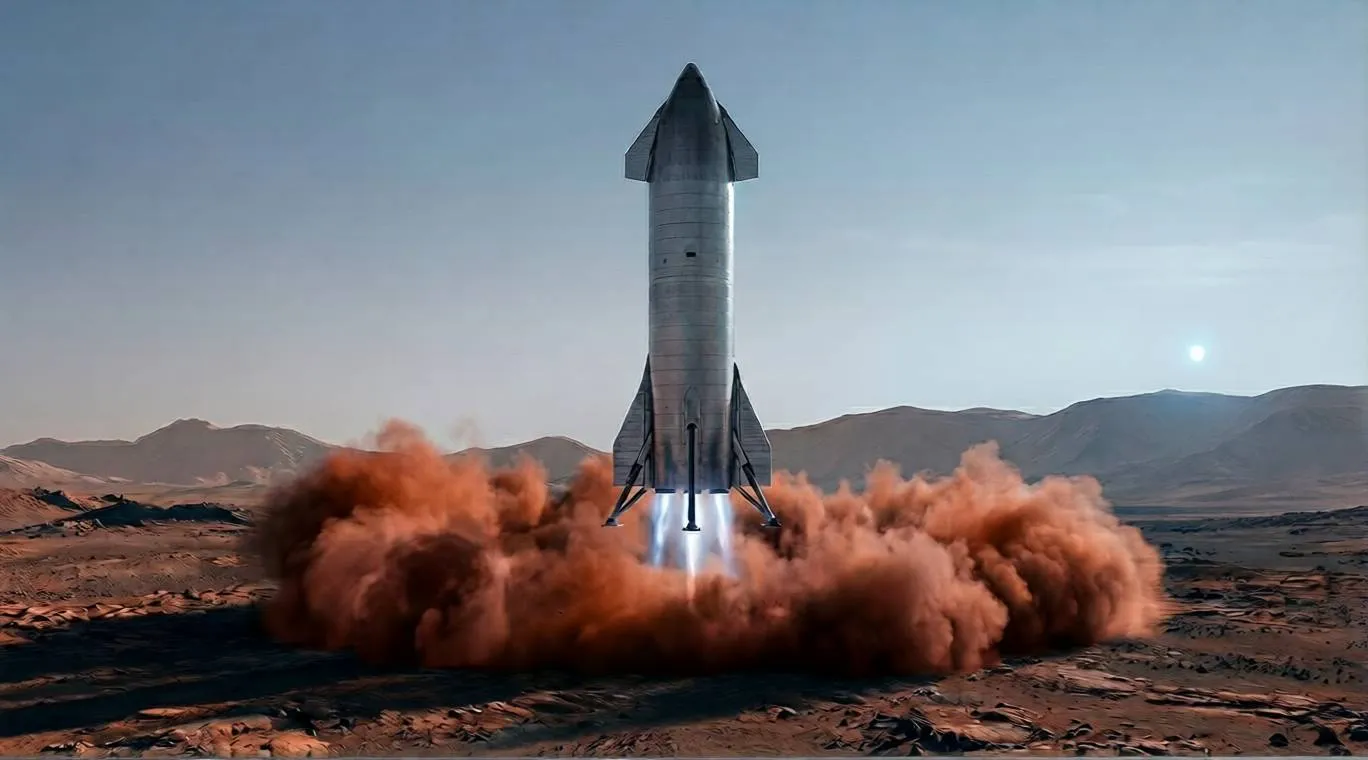
At the opposite end of Japanese surgical refinement is the assumption of catastrophic risks and the application of logistical brute force led by the American company SpaceX. Elon Musk's company will use this late 2026 window to launch a test fleet of up to five uncrewed Starship vehicles to Mars. The goal is not to perform delicate science, but to survive extreme thermodynamics. They want to check if the huge stainless steel structure of the V3 version can withstand the Martian atmospheric reentry at seven kilometers per second without melting, mitigating the oxidizing plasma to attempt a vertical landing.
The true bottleneck of this feat is not on Mars, but in Earth orbit. Starships must be refueled in space before departing, a process that involves the transfer of nearly four hundred metric tons of subcooled liquid oxygen and methane between ships. Mastering cryogenic fluid management in microgravity is a fight against thermodynamics, especially against thermal evaporation or boil-off. This is like trying to keep an ice cube intact under the scorching desert sun while waiting hours for more ice cubes to be brought to fill the cooler; the propellant boils and is lost in the vacuum, requiring a dizzying cadence of tanker rocket launches from Earth. Although progress is slow and Musk is often prey to his own exaggerated optimism, the validation of this logistical architecture would forever redefine commercial access to other worlds.
The Awakening of the Asian Giant and the Future
While the West hesitates and outsources its future to the private sector, China advances quietly but with overwhelming determination. Its Tianwen-3 mission, scheduled for the next window in 2028, is an exercise in technological sovereignty. Using two independent super-heavy rockets, they plan to land, drill, execute an autonomous docking in Martian orbit, and return half a kilogram of pristine material by 2031, also incorporating instruments from international consortia that have seen in Beijing the temporal reliability that NASA has lost.
In short, this year 2026 is not a valley of inactivity, but the noisy construction workshop of the future space age. The dynamics have irreversibly changed. Pure science and precision astrobiology now rely on Eastern miniaturization, while the raw industrial strength necessary to forge true trans-solar logistical highways rests on the shoulders of private corporations that see test explosions as a simple formality toward progress. The road to a multiplanetary destiny is bureaucratic, thermally hostile, and very expensive, but this year the definitive seeds have been sown to conquer it. See you at the next launch window, keep your eyes on the night sky!
Related
Missions
- 🛰️ Perseverance
Related news and articles
- 📰 Tianwen-3: The New Paradigm of Martian Exploration and Geopolitical Reconfiguration 6 MAY 2026
- 📰 The Rebirth of Rosalind Franklin: Geopolitics, Martian Drills, and the Search for Subsurface Life 26 NOV 2025
- 📰 Mars in May 2026: Technical and Geopolitical Reality 2 MAY 2026
- 📰 ExoMars and Parachute Sterilization: Technical Rigor to Avoid Contaminating Mars 1 MAY 2026
Marspedia terms
Enjoyed it? Keep exploring
Back to all news