
The end of rolling hegemony and interplanetary bureaucracy
Since the dawn of the space race, our romance with Mars has been dominated by an unyielding paradigm: sending rolling laboratories to a slow but glorious death. Agencies like NASA have invested decades and pharaonic budgets in perfecting the rocker-bogie suspension system, an engineering feat that, nevertheless, suffers from a fatal weakness in the face of the red planet's inclement topography. The reality is that space exploration is not a fast-paced science fiction movie, but rather a painfully slow process, marked by years of bureaucratic paperwork, committee meetings, and daily progress that is often measured in centimeters. Wheels demand continuous contact with the ground, and when that ground is a death trap of fine dust and sharp basalt, heavy rovers like Perseverance suffer devastating structural wear. To understand the magnitude of the problem, imagine trying to drive a sports car with bald tires through a junkyard full of razor blades and quicksand —a guaranteed recipe for absolute disaster and immobilization—.
Jumping biomechanics and alien simulations
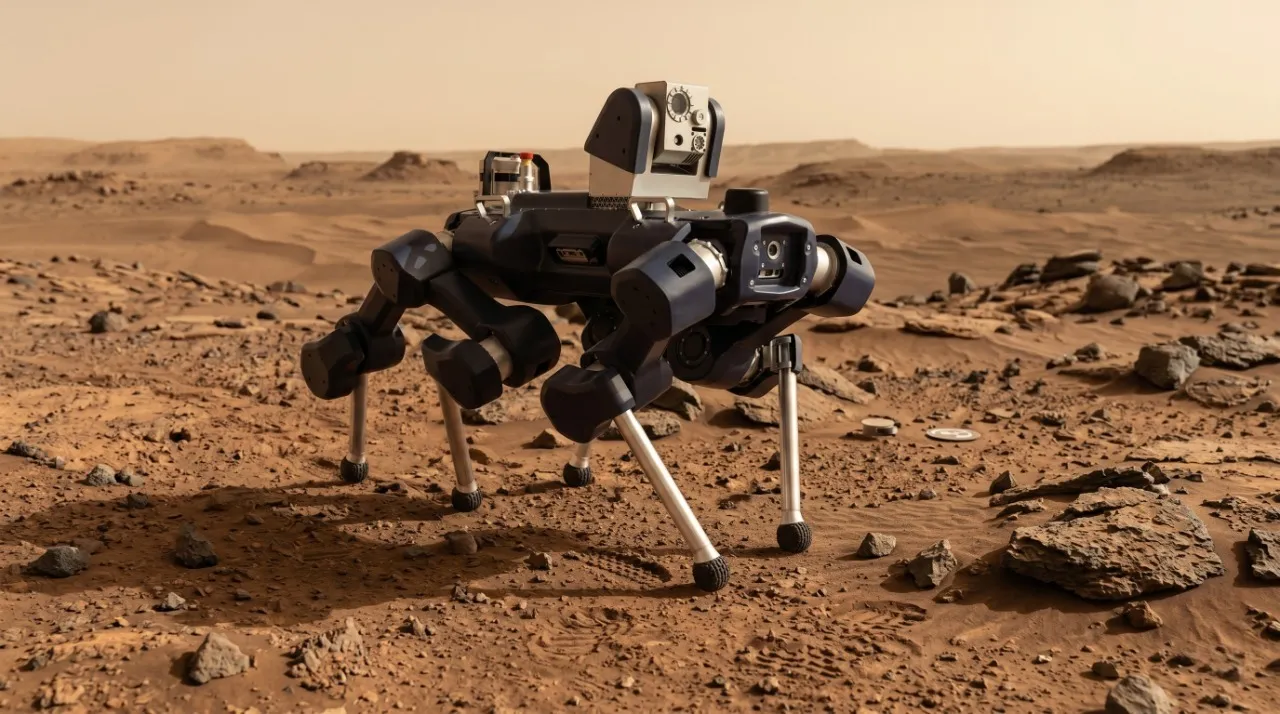
Faced with this kinematic dead end, a consortium of European institutions has decided to radically change the approach. Instead of forcing a machine to roll over insurmountable obstacles, they have developed biomimetic quadruped platforms such as ANYmal and the Olympus prototype. These mechanical explorers abandon the continuous footprint for discrete contact, using double-jointed limbs to propel themselves. In an environment where gravity is barely 38 percent of Earth's, jumping ceases to be an energy waste and becomes the most efficient mobility tactic. Curiously, the biggest challenge was not designing the metal legs, but teaching the machine not to crash during prolonged ballistic flights. Using Reinforcement Learning, an advanced branch of artificial intelligence, engineers trained the robot in hyper-realistic simulations. The machine autonomously learned to flail its limbs in the air to correct its posture, a maneuver that instinctively mimics the movement of a cat trying to land on its feet after being thrown into the void.
Robotic speleology and the long road ahead
The agility of these quadrupeds is not an end in itself, but the ideal transport for a revolutionary scientific payload. Equipped with miniaturized instruments like the MICRO imager and the portable Raman spectrometer, these explorers can analyze Martian geological history without the need to drill or destroy valuable samples. By firing a laser and reading how the color of the bounced light changes —exactly like a supermarket scanner reading a quantum barcode— they can identify minerals with astonishing precision. However, we must banish any unfounded hype: we will not see gleaming colonies on Mars tomorrow, progress will continue to be bureaucratic and deliberate. But these robotic dogs finally unlock the ability to delve into immense underground lava tubes, relics of ancient volcanic activity that act as natural shields against lethal cosmic radiation. It is in the pristine darkness of those caverns, far beyond the reach of any traditional wheel, where the definitive answers about the past of our solar system patiently wait.
Related
Missions
- 🛰️ Perseverance
- 🛰️ Dawn
Related news and articles
- 📰 The Rebirth of Rosalind Franklin: Geopolitics, Martian Drills, and the Search for Subsurface Life 26 NOV 2025
- 📰 Japan Prepares the First Round-Trip Mission to Mars with the MMX Probe 18 OCT 2026
- 📰 Stratigraphic Continuity Between Oxia Planum and Mawrth Vallis: The Great Window into Mars' Habitable Past 27 JUN 2026
- 📰 The Strategic Shift Toward the Moon Base Reconfigures ESA's Alliances With NASA 15 JUN 2026
Marspedia terms
Enjoyed it? Keep exploring
Back to all news