
The Geopolitical Puzzle of Martian Exploration
The history of the ExoMars mission is, above all, a lesson in bureaucratic resilience and technical adaptation. Originally conceived as a deep collaboration with Russia, the invasion of Ukraine in 2022 forced the European Space Agency to halt a launch that was practically ready to go. This plot twist —a reminder that science does not live in a bubble detached from terrestrial politics— forced engineers to seek a new ally in NASA under the ROSA project. Curiously, this delay until 2028 has allowed for the refinement of protocols that in other circumstances would have been much more tightly scheduled. The transition from a Russian landing platform to a European one with American technology is not just a change of parts, but a complete re-engineering that must ensure the Rosalind Franklin rover reaches its destination with the maximum guarantee of safety and, above all, biological cleanliness.
The Technical Bakery: Dry Heat Sterilization
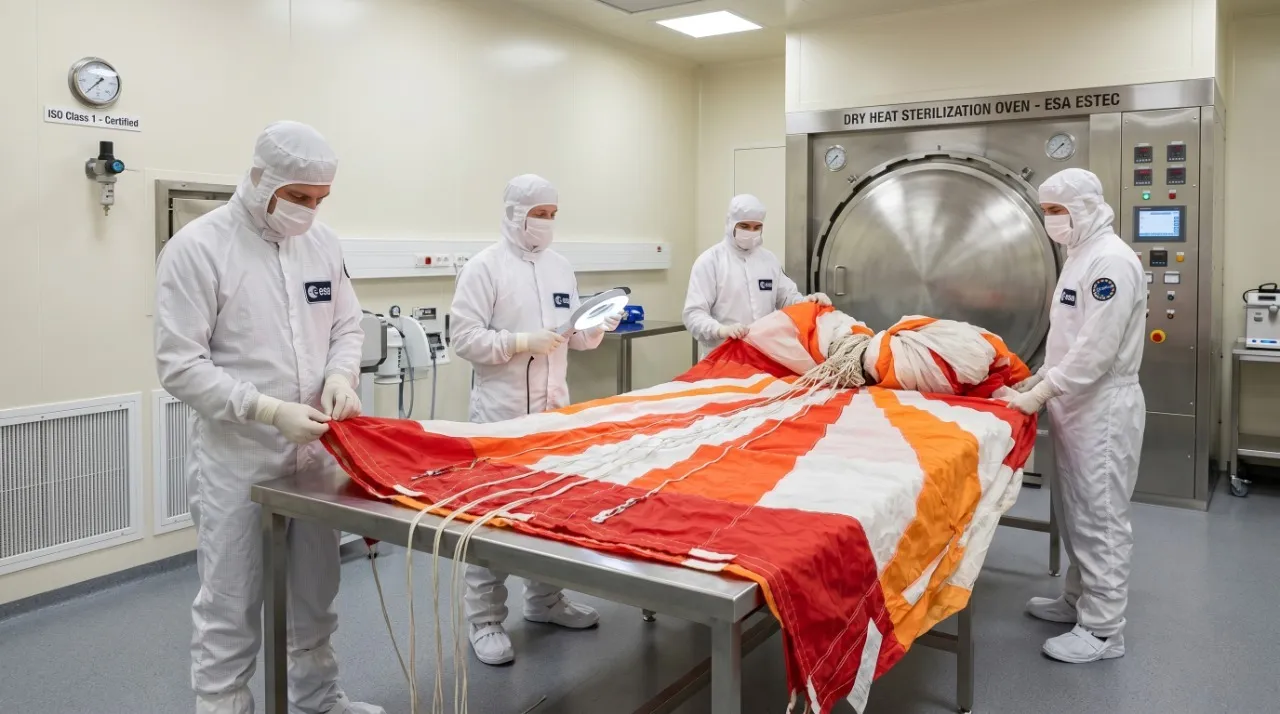
One of the most recent milestones has been the dry heat microbial reduction process, technically known as DHMR, applied to the parachute system at the ESTEC center in the Netherlands. For over 79 hours, this 74-kilogram component was subjected to a constant temperature of 125°C inside an ISO Class 1 cleanroom. To visualize the rigor of this cleaning, we can imagine we are trying to clean a corner of our house with such a level of detail that, after the process, a single remaining speck of dust would seem as large and obvious as a mountain on a clear horizon. This procedure is vital to comply with COSPAR planetary protection category IVb. The goal is to eliminate any residual bioburden; if a single terrestrial spore were to survive and be detected by the rover on Mars, the scientific result would be a disastrous false positive that would invalidate years of investment and work.
Materials Engineering Versus Supersonic Deployment
The challenge lies not only in the cleaning but in ensuring that the materials survive that thermal treatment without losing their mechanical properties. The second-stage parachute, which at 35 meters in diameter is the largest sent to another planet, is made from a blend of Nylon and Kevlar. These polymers must be able to go through the "oven" and, months later, withstand a braking process that reduces the module's speed from 21,000 km/h to a soft landing. It is a delicate balance —similar to asking a fine piece of clothing to go through an industrial washing machine at maximum temperature and, upon coming out, be capable of holding the weight of a truck without tearing—. High-altitude drop tests conducted in the Swedish Arctic have confirmed that the design is robust, but the baking process adds a layer of technical complexity that tests the structural durability of synthetic fibers against oxidative degradation.
The Subsurface as Mars' Biological Archive
The true crown jewel of the mission is its deep drilling capability. While other explorers have barely scratched the Martian surface, the Rosalind Franklin is equipped with a drill that can descend up to two meters deep. This distinction is fundamental because the surface of Mars is a radioactive desert where cosmic rays and perchlorates act as a chemical eraser that removes any organic trace. By drilling into the subsoil, the rover accesses a "library" that has been protected for billions of years by the Martian regolith. Curiously, the landing site at Oxia Planum was chosen precisely for its richness in clays, indicating a past where pH-neutral water could have allowed life to develop. If there are answers about our solitude in the universe, they are most likely not in plain sight, but buried under layers of time and dust.
Scientific Realism and the Road to 2028
It is important to keep our feet on the ground and understand that ExoMars is not a race of speed, but an exercise in extreme patience. The integration of the new NASA braking engines and radioisotope heating units is a process that consumes years of certifications and testing. Success in parachute sterilization is a solid step, but the 2028 launch window remains a logistically tense target. Space science advances at a ceremonial pace, where every millimeter of progress is backed by mountains of data and verifications. At the end of the day, the ExoMars mission personifies the human will to explore, but also the ethical responsibility not to contaminate what we are trying to understand. If we manage to find biosignatures in the subsoil of Oxia Planum, it will be because today we were meticulous enough to bake a parachute to absolute sterility.
Related
Related news and articles
- 📰 The Rebirth of Rosalind Franklin: Geopolitics, Martian Drills, and the Search for Subsurface Life 26 NOV 2025
- 📰 Stratigraphic Continuity Between Oxia Planum and Mawrth Vallis: The Great Window into Mars' Habitable Past 27 JUN 2026
- 📰 Tianwen-3: The New Paradigm of Martian Exploration and Geopolitical Reconfiguration 6 MAY 2026
- 📰 The Era of Interplanetary Alliances: The Aeolus Mission and NASA's New Paradigm on Mars 24 JUN 2026
Marspedia terms
Enjoyed it? Keep exploring
Back to all news