
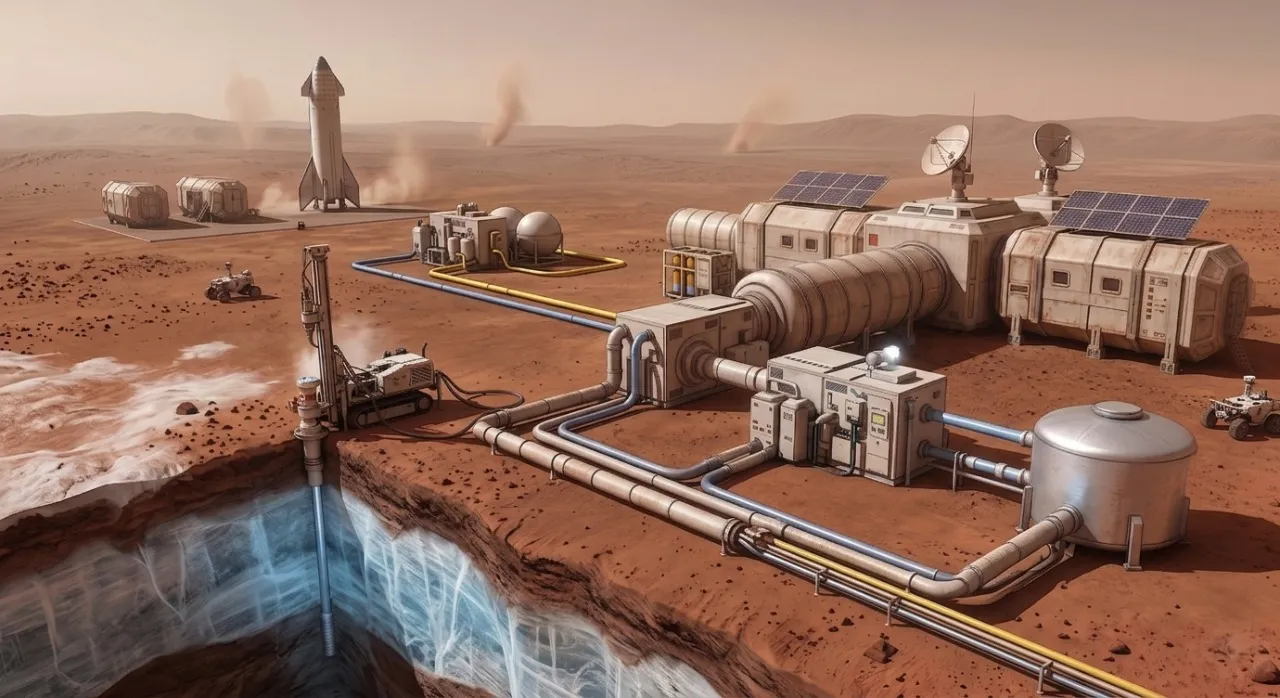
Any plumber's dream: miles of pipes exposed to dust storms and -60°C without a single meter of thermal insulation. The optimism of the scene is refreshing.
The feasibility of establishing a permanent human presence on Mars is inextricably linked to a golden rule of aerospace engineering: in situ resource utilization. We cannot carry the success of the mission packed into the cargo bays of our rockets. Among all the elements available in the Martian environment, water stands out as the most critical resource. Its utility transcends the mere biological survival of the crew —that is, quenching the astronauts' thirst or watering future crops—; it constitutes the fundamental raw material for generating breathable oxygen in the base and synthesizing the propellants required to operate the Martian Ascent Vehicle. Without the local production of these compounds, the design of manned missions becomes prohibitive from the perspective of launch mass and interplanetary logistical costs.
The cruel equation of rocket physics
The cruel equation of rocket physics
The economic and physical justification for extracting water on Mars lies in the severe mass penalty imposed by space travel. For every kilogram of payload deposited on the Martian surface, between seven and eleven kilograms of mass must be launched into low Earth orbit —a ratio that turns every gram in space into an item of absolute luxury—. For the return journey, the ascent vehicle needs a supply of approximately twenty-three metric tons of liquid oxygen and more than six tons of liquid methane as propellants. If we had to ship all that fuel from Earth, the dead weight would force up to five additional launches of humanity's heaviest rockets just for return logistics. Curiously, chemistry offers us a way out through the well-known Sabatier reaction, a process that combines carbon dioxide from the Martian atmosphere with hydrogen to generate methane and water. If we chose to import hydrogen from Earth to avoid local water mining, cryogenic storage would present intolerable losses due to spontaneous evaporation or boil-off. Thermodynamics imposes the absolute necessity of extracting water locally, offering up to a six-fold improvement in the ratio of propellant generated per unit of landed Earth mass.
Mining glaciers under the Martian desert
The most stable, massive, and pure water reserve on Mars is located in the form of underground ice in the planet's middle latitudes. Vast glacial sheets are hidden protected by layers of dry regolith that act as a natural thermal insulation, much like how a blanket of sawdust preserved ice in old terrestrial warehouses. In the Arcadia Planitia region, radar profiles reveal a gigantic water ice sheet that extends up to forty meters deep over an area of one million square kilometers. Thermal data suggest that this deposit is located at extremely shallow depths, in some places less than thirty centimeters below the surface, which would greatly facilitate initial access.
However, the physical environment of Mars imposes severe restrictions on mining work. Since subsurface temperatures constantly remain below minus forty degrees Celsius, Martian water ice exhibits a mechanical hardness equivalent to that of Earth's basalt, making simple mechanical excavation methods impossible without critical tool wear. To solve this challenge, cutting-edge engineering has developed systems that combine flexible pipe drilling with the architecture of a Rodriguez Well. This technique, successfully used in the glaciers of Antarctica, uses heat to melt cavities of liquid water inside the ice. The process requires hermetically sealing the well using a pneumatic packer. This step is critical because the average atmospheric pressure on the Martian surface is so low that it hovers around the triple point of water; any heating of the ice without a pressure seal would cause direct sublimation, meaning the ice would instantly transform into gas without passing through the liquid state, causing the collapse of the well. Once pressurized, heaters melt the surrounding ice and a submersible pump suctions the purified water to the surface.
Squeezing the subtle moisture from the atmosphere
The atmosphere of Mars is extremely dry compared to that of Earth, but it maintains a very high state of relative saturation during the frigid Martian nights due to the plunge in temperatures. To capture this moisture continuously, scientists have designed the water vapor adsorption reactor. The device uses a high-flow axial fan, aerodynamically optimized to operate in the planet's thin atmosphere, which forces air through a bed of type 3A zeolite. This material functions as an ultra-specific molecular sieve: its pores measure exactly three angstroms, the perfect size to trap water molecules by physical affinity while the carbon dioxide molecules from the atmosphere, being larger, flow through the filter without clogging it.
Once the mineral bed is saturated with moisture, it rotates inside a hermetic desorption chamber where it is bombarded by microwaves at the same dielectric frequency as liquid water. Curiously, this process heats the water uniformly without degrading the mineral matrix, releasing the vapor into a condenser where it instantly freezes by taking advantage of the outside nocturnal cold. The great challenge of this system is the extremely low density of the standard atmosphere, which would force the use of colossal compressors to suction the necessary volume. However, if the system is deployed in areas with unique humid microclimates, such as the bottom of the Valles Marineris canyons where dense morning ice fogs form, the volume of required air drops drastically, making the technology fully compatible with the industrial equipment we already use on Earth.
The closed loop of the Martian home
Regardless of the efficiency of external extraction methods, the internal conservation of fluids is mandatory in any long-duration Martian habitat. The design objective is to achieve a closed water cycle with a recovery rate equal to or greater than ninety-eight percent, minimizing the need for external resupply. The direct model for these habitats is the life support system of the International Space Station, which combines ambient condensation moisture —the sweat and breath of the crew— with pre-distilled urine. However, the classic distillation of urine is limited by the high concentration of calcium sulfate derived from the bone loss suffered by astronauts in weightlessness, which generates a corrosive and pastive brine that blocks the conduits.
The modern implementation of brine processors using selective permeable polymer membranes has overcome this obstacle, evaporating clean water and retaining dry contaminants in replaceable filters. When transferring this technology to the surface of Mars, physics offers us a curious relief: Martian partial gravity —thirty-eight percent of Earth's— eliminates the need for the complex fluid centrifuges used in space, allowing the separation of gases and liquids to occur by natural decantation. On the other hand, the great danger on Mars comes from the outside: Martian dust is an abrasive, tiny, and electrostatically charged enemy that can destroy hydraulic pumps, and chemically it harbors perchlorate salts highly toxic to the human body. If this dust penetrates the habitat's water circuit, the salts will dissolve rapidly, forcing purification systems to incorporate advanced high-pressure reverse osmosis modules to guarantee water potability.
Reflections on a self-sufficient future
Engineering shows us that the conquest of Mars does not depend on the abundance of resources, but on our thermodynamic acuity to manage them. The water is there, waiting in the cryogenic subsurface, in the canyon fogs, and in the biological systems of the explorers themselves. The viability of future interplanetary cities will depend on a hybrid ecosystem where glacier mining serves as the industrial engine for the return fuel, atmospheric capture functions as an inexhaustible safety net, and domestic recycling acts as a temple of absolute efficiency. By taming the water cycle in the most hostile environment we have ever stepped on, humanity will not only ensure its survival on Mars, but will definitively learn to value the balance and fragility of the resources of our own blue planet.