
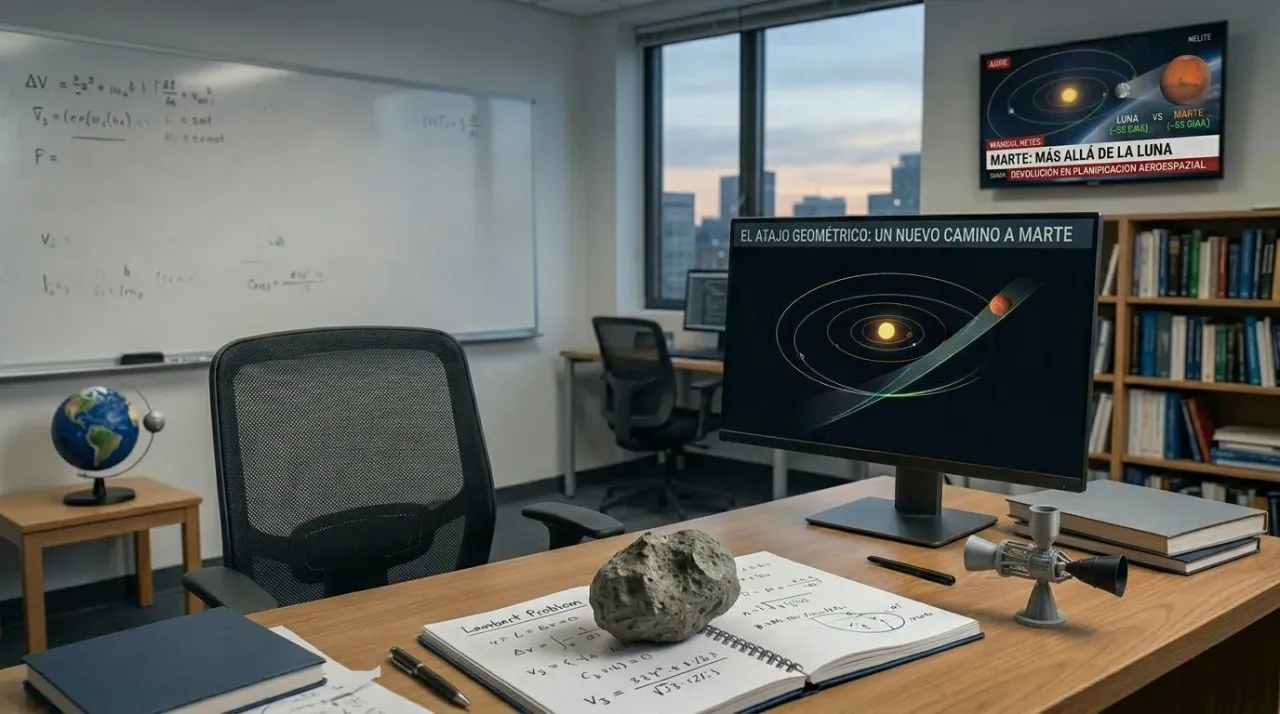
The Appeal of Mars and the Challenge of Cosmic Distances
Since the dawn of civilization, when the first astronomers began mapping the night sky, the planet Mars has occupied a place of undeniable privilege in the collective imagination and at the forefront of the global scientific agenda. The world's most prominent space agencies consider Mars their fundamental horizon objective. This designation is no accident, as the red planet represents one of the few places in our solar system where geological conditions suggest life may have once existed. Recent discoveries of hidden organic molecules, immense subterranean ice oceans, and evidence of ancient hydrological networks only intensify the immense scientific value of this neighboring world. However, the dream of establishing a human presence has historically collided with an invisible but relentless wall: the mathematical tyranny of cosmic distances and the strict limitations imposed by traditional orbital mechanics. To understand the magnitude of this challenge, it is highly useful to draw a comparison; when the historic missions of the Apollo program cross the vast void to the Moon, they cover about 380,000 kilometers in a few days. Mars, on the other hand, is an independent planet whose distance from Earth constantly stretches and compresses. At best, a trip to the red planet involves traversing a distance roughly 145 times greater than the lunar distance. This extreme remoteness means that traveling to Mars is not a simple, predictable summer logistics jump; it is a sustained temporal exile in the absolute void that lasts for months. Faced with this overwhelming spatial reality, recent news of the discovery of an unusual shortcut has profoundly shaken aerospace planning, detailing a theoretical route that would allow a complete mission in just 153 days.
Understanding Orbital Physics and the Hohmann Transfer
To fully appreciate the genius behind this discovery, recently published in the scientific journal Acta Astronautica, it is necessary to demystify how space travel works. In deep space, the concept of traveling in a straight line has no practical use. The inertia of the solar system forces spacecraft to travel by carefully widening their orbit around the Sun through a maneuver dictated by the vis-viva equation. This critical change in velocity is called "Delta v". The standard method to achieve this journey with maximum energy savings is known as the Hohmann Transfer Orbit, a concept that uses the solar system's natural inertia to allow the ship to glide silently until it intercepts its destination. However, this high efficiency exacts an exorbitant price in time, requiring Earth and Mars to be specifically aligned during the so-called Mars Opposition, a launch window that only occurs once every 26 months. Historically, unmanned missions have demonstrated the extreme slowness of this route, averaging uninterrupted transit times of seven to ten months. Once there, the crew would be forced to wait patiently on the Martian surface until the next return window opened, turning the mission into an astonishing commitment of nearly three Earth years.
The Mathematical Ghost of Asteroid 2001 CA21
It is precisely against this immense backdrop that the discovery of a 153-day round trip acquires its status as a revolution. The author of this conceptual innovation is not a multibillion-dollar corporation, but Marcelo de Oliveira Souza, a researcher from the State University of Northern Fluminense in Brazil. Souza dedicated over a decade to patiently analyzing asteroid trajectories, a long-term planning endeavor that was both strategic and highly meticulous. The most disruptive element of his success was the material used: the early, and often discarded, orbital projections of Near-Earth Objects. Interestingly, Souza inverted the traditional paradigm and decided not to discard this noisy data, treating it as valuable geometric profiles. He focused his analytical attention on the asteroid 2001 CA21, whose preliminary orbit crossed the solar system's plane with a constant inclination of five degrees. By applying this trail as a pure template to solve the complex Lambert's Problem, he managed to isolate astonishingly direct and stable trajectories that normal algorithms would never have found.
The Magic Window of 2031 and Mission Scenarios
Discovering this geometric path required projecting the angular constraint against the calendar of upcoming Martian oppositions. The windows of 2027 and 2029 proved to be mathematical dead ends, but when simulating the opposition window scheduled for the year 2031, the models yielded a prodigious alignment that synchronizes the asteroid's geometric architecture with both planets, allowing for a rapid outbound flight and an immediate return. The first proposed scenario is an extreme 153-day mission, which would require leaving Earth anchored to the asteroid's plane around April 20, 2031, reaching the red planet after a blinding transit of just 33 days. After an intensive 30-day surface stay, the crew would begin their return to arrive home in September via a 90-day journey. Aware of physical limits, researchers mapped out a second, more feasible scenario totaling 226 days. On this route, the outbound transit would require 56 days of navigation with an estimated arrival in mid-June 2031, allowing for 35 days of surface operations and ensuring a dynamically coherent return in about 135 days of flight.
The Technological Wall of Energy and Thermal Friction
The harsh reality of space engineering demands prudence, as reducing an interplanetary journey to a third of its time exacts a colossal toll in terms of propulsion. To achieve the feasible 56-day route, the vehicle would need to generate a monumental characteristic energy or C3 of 285 square kilometers per second squared, an astronomical figure considering that current standard missions impart only between 10 and 15 units of C3. The extreme route would demand an exorbitant 758 square kilometers per second squared. Accelerating thousands of kilograms of human mass and life support to these speeds is mathematically unattainable with contemporary chemical propulsion, making the future deployment of the Nuclear Thermal Rocket imperative. Furthermore, braking this immense excess of kinetic energy upon arrival presents an apocalyptic thermal problem. An arrival in 33 days would force the spacecraft to ram into Mars' thin atmosphere at speeds approaching 108,000 kilometers per hour. Thermodynamics dictate that friction would almost instantly evaporate any conventional ablative heat shield, vaporizing the entire ship before it touches the ground. Braking propulsively in space would, in turn, require carrying thousands of tons of extra fuel, demonstrating a clear evolutionary desynchronization between our astrodynamic calculation software and our slow heavy materials engineering.
The Human Factor and Logistic Survival
The real reason astrophysicists stubbornly pursue these invisible corridors is fundamentally biomedical and logistical. Coordinating and supplying uninterrupted vital provisions for a crew trapped in the cosmic darkness for three full years is a colossal organizational nightmare; the added dead weight makes the launch astronomically expensive. Moreover, the human body suffers aggressive degradation when chronically exposed to galactic radiation and microgravity, undergoing severe cellular atrophy. Compressing the flight would radically mitigate this exposure, making the physiological stress similar to that of standard deployments in low Earth orbit. Redefining space exploration by harnessing these natural corridors pre-calculated by gravity is not simply an exotic exercise, but the indispensable map of survival that will transform reckless interplanetary feats into sustainable expeditions, finally opening the geometric and logistical door toward the true conquest of the Martian horizon.
Related
Missions
- 🛰️ Dawn
Related news and articles
- 📰 The Martian Slingshot: How the Psyche Mission Leverages Gravity and Bureaucracy to Reach a Metal World 16 MAY 2026
- 📰 The Fallen Shield: How the ESCAPADE Mission Will Unveil Mars' Atmospheric Agony 14 NOV 2025
- 📰 Tianwen-3: The New Paradigm of Martian Exploration and Geopolitical Reconfiguration 6 MAY 2026
- 📰 The Meridian of Precision: The Silent Adjustment of January 6, 2000 7 JAN 2026
Marspedia terms
Enjoyed it? Keep exploring
Back to all news