
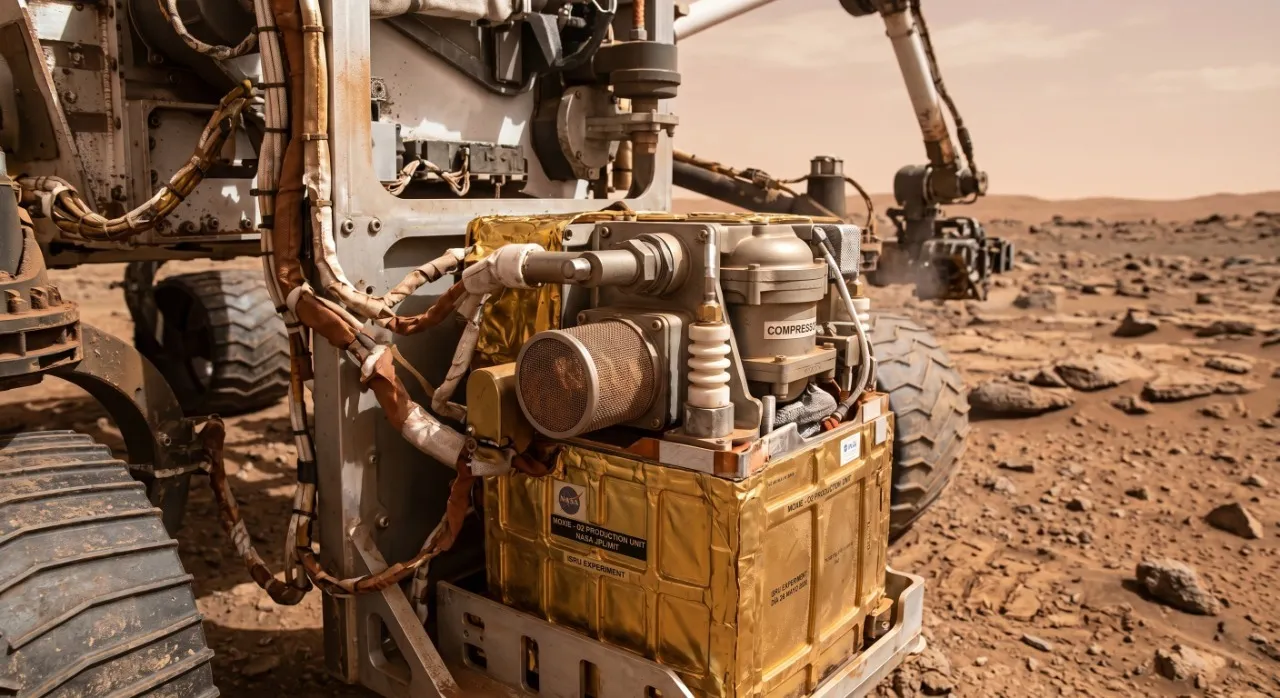
Making air on the Red Planet. MOXIE's golden box proving that the future of space exploration relies on learning to breathe on Mars.
The human conquest of deep space depends on a mathematical rule as implacable as gravity: the mass gear ratio. With current chemical propulsion technology, placing a single ton of payload on the surface of Mars requires launching between eleven and thirty tons into low Earth orbit. Curiously, most of that dead weight is not the astronauts or their provisions, but the very fuel needed to return home. For a crew of four to six people to blast off from the Martian ground and undertake the return journey, an estimated twenty-four to thirty-one metric tons of liquid oxygen is required exclusively for the ascent maneuver. Transporting this colossal ocean of oxidant from Earth is prohibitive. It is the cosmic equivalent of trying to go on a road trip across a desolate desert while carrying in a trailer all the gasoline you will consume on the way there and back; the very weight of the extra fuel would end up stopping the vehicle.
The birth of atmospheric mining
To break this vicious cycle of aerospace engineering, scientists proposed a bold strategy: In Situ Resource Utilization. Instead of bringing air from home, the idea is to manufacture it directly at the destination by taking advantage of local raw materials. The first historic step toward this form of planetary mining was consolidated thanks to the Mars Oxygen ISRU Experiment, a compact gold-plated instrument affectionately known as MOXIE, which traveled to the red planet integrated into the chassis of the Perseverance rover during NASA's Mars 2020 mission. This technological marvel inherits the conceptual legacy of the Mars Isotopic Propellant Production Precursor, a system originally designed for the tragic and canceled Mars Surveyor 2001 Lander mission. Decades later, the design was scaled and adapted to the strict energetic limitations of the rover to prove that Martian soil can be a functional service station.
Physically, MOXIE is a masterpiece of insulation engineering. Housed in the internal right section of the rover, it is protected by an aluminum box with a pure gold coating. This precious metal does not aim for luxury, but for efficiency: it acts as a thermal shield with very low emissivity that reflects the infrared radiation generated inside, preventing extreme heat from damaging the delicate surrounding electronics. Curiously, the inside of the apparatus is encapsulated with an ultralight silica aerogel and ceramic materials, a technological coat that provides perfect insulation to contain the infernal temperatures of the reactor while the rover operates in the freezing Martian environment. The instrument was optimized to function intermittently, consuming a total budget of one thousand watt-hours per Martian sol to cover thermal warm-up and ensure one hour of net oxygen production with a mass of just seventeen kilograms.
The challenge of compressing the vacuum
The first major obstacle this system must overcome is the very nature of Mars's atmosphere. Although Martian air is dominated ninety-five percent by carbon dioxide, the pressure at the surface of Jezero Crater is barely six millibars, less than one percent of Earth's atmospheric pressure. Trying to extract oxygen from such a thin air is like trying to breathe through a tiny straw at the top of Mount Everest; the molecules are so scattered that chemical reaction cells cannot operate efficiently due to severe limitations in mass transfer.
The process begins when the gas is sucked through a high-efficiency filter designed to trap the fine dust particles suspended in the Martian sky. The accumulation of this dust is a critical risk that could choke the intake system. To mitigate this danger, engineers designed a physical baffle prior to the filter that induces sudden changes in the gas direction. The heavier dust particles, unable to turn so quickly due to their own inertia, crash against the walls of the baffle and are deflected, allowing only clean gas to reach the HEPA filter. Once free of impurities, the air enters the heart of the compressor: a mechanical scroll mechanism that spins between two thousand and four thousand revolutions per minute. This compressor mechanically compresses the thin Martian gas using concentric spirals, acting analogously to a hydraulic press that compacts a spongy material to concentrate all its mass into a reduced volume.
The electrochemical alchemy of solid oxide
Once the carbon dioxide is pressurized and preheated to about eight hundred degrees Celsius, it is introduced into the Solid Oxide Electrolysis reactor. This reactor is configured as a vertical stack of ten individual cells interconnected in series. Unlike commercial terrestrial designs that usually support the cells on the anode to favor conductivity at lower temperatures, MOXIE's reactor implements a configuration supported by the ceramic electrolyte itself. This structure provides enormous robustness against the brutal mechanical shocks of launch and planetary descent. The central membrane of each cell is made from a sheet of scandia-stabilized zirconia, a special ceramic material that, upon reaching extreme temperatures, becomes permeable exclusively to oxygen ions, functioning as a perfect atomic sieve.
The electrochemical process is a dance of electrons. At the cathode, composed of a thirty-micrometer-thick porous nickel layer, carbon dioxide molecules absorb electrons from the electrical circuit and dissociate, releasing gaseous carbon monoxide and negatively charged oxygen ions. These ions migrate selectively through the crystal vacancies of the ceramic membrane making sure to leave behind any other molecule. Upon arriving at the anode, made of a special ceramic perovskite that prevents the electrode from delaminating under high continuous current regimes, the ions surrender their extra electrons and recombine to form stable molecules of pure oxygen. To prevent leaks and electrically isolate the components, specialized alkali-free glass-ceramic seals are used, which melt in situ during manufacturing, ensuring absolute tightness even after enduring extreme cold and heat thermal cycles.
Curiously, the operation of the reactor requires a millimetric physical balance. If the voltage applied to the cells exceeds a critical thermodynamic limit dictated by Nernst equations, the gaseous carbon monoxide will undergo a secondary reduction and transform into solid elemental carbon. This phenomenon, known as coking, would deposit a layer of carbon that would irreversibly clog the nickel pores of the cathode, ruining the instrument. It is the equivalent of a car engine suffering a massive accumulation of internal soot until it seizes completely. To prevent this, the control system constantly monitors ohmic and activation overpotentials, adjusting the current to operate strictly within the safe window between the primary dissociation potential and the carbon formation potential. Since the reactor experiences unavoidable thermal gradients of up to ten degrees between the outer and inner cells, the algorithm adopts a conservative stance and calculates limits assuming the entire system is at the temperature of the coldest cell.
The verdict of the Martian campaigns
Each operational cycle of MOXIE on the surface of Mars was divided into two main stages managed by automated control software. First, the thermal warm-up phase was initiated, where resistive heaters raised the internal temperature from sixty-five degrees below zero in the Martian winter to the eight hundred degrees of operation at a controlled rate of five hundred fifteen degrees per hour. Once the system stabilized, the electrochemical production phase was started for one hour. To sharpen the focus before each execution, the instrument performed a reference sweep, varying the current in steps to calculate the specific area resistance of the reactor. To enrich this analysis, scientists crossed the instrument's telemetry with the environmental readings from the rover's MEDA weather station, analyzing how variations in atmospheric pressure, wind speed, and dust opacity influenced the compressor's performance.
Between February twenty twenty-one and August twenty twenty-three, MOXIE successfully completed sixteen scientific production campaigns spanning all seasons of the Martian year, demonstrating its resilience in both freezing winter nights and blistering summer suns. Throughout these runs, the instrument accumulated a total of one hundred twenty-two grams of high-purity oxygen, operating without registering a single mechanical or electrical failure. Curiously, the production rate varied in parallel with planetary pressure cycles, which fluctuate drastically throughout the year as carbon dioxide at the poles sublimates or freezes. During the solstice of maximum seasonal density, the team pushed the system parameters and managed to break historical performance records, reaching production peaks of up to ten point fifty-six grams per hour on sol six hundred thirty of the mission.
The road to colonization in the 2030s
MOXIE's achievement completely validates the physics of space resource utilization, but the engineering challenge that remains to sustain a manned mission in the twenty-thirty decade is massive. Perseverance's instrument was designed to prove the concept by operating at one percent of the required scale. A human industrial plant will not be able to work in short intermittent periods; it must operate continuously for fourteen to sixteen months to autonomously fill the tanks of the ascent vehicle. To achieve this, the real facility will require a huge assembly of about one hundred electrolysis stacks running in parallel, which will demand a constant power supply of about twelve kilowatts, dedicated exclusively to the reactor.
Such a massive demand implies processing eight kilograms of Martian atmosphere per hour, a gas flow so large that mechanical scroll compressors would suffer unsustainable wear on their seals due to continuous friction over ten thousand hours of service. To solve this hurdle, NASA's Kennedy Space Center leads the development of an advanced full-scale carbon dioxide freezer project. The physical principle of this system dispenses with moving parts prone to failure: it uses a closed-cycle cryogenic refrigerator to cool the fins of a chamber down to one hundred twenty-five degrees below zero. When Martian air passes through these ultra-cold walls, the carbon dioxide condenses directly into a solid state, accumulating as dry ice snow.
Once the required mass is collected, residual fractions of inert gases like nitrogen and argon are purged from the system. Subsequently, the chamber is hermetically isolated and actively heated using resistors or passively heated via Martian ambient daytime heat. This thermal increase causes the controlled sublimation of the carbon dioxide snow, transforming it directly into a high-density pressurized gas stream that feeds the reactor constantly and smoothly, completely eliminating the need for a dynamic mechanical compressor. Furthermore, the future plant will require the implementation of individual four-point voltage sensing lines in each of the cells to directly monitor the real electrochemical potential without the errors induced by the resistance of the power terminals.
Learning to extract air from the thin atmosphere of Mars represents a fundamental milestone in our evolution as a species. By proving that we can transform the resources of a hostile alien environment into the essential elements for our survival and return, we stop being mere helpless visitors and become self-sufficient inhabitants of the cosmos. MOXIE's silent success in Jezero Crater reminds us that the frontiers of space are not conquered solely by the brute force of rockets, but by the subtle and elegant intelligence of applied thermodynamics. The next time we look toward the reddish glow of the night sky, we will know that up there, a small machine has already breathed for us, awaiting the moment when our own lungs do the same on the surface of a new world.