
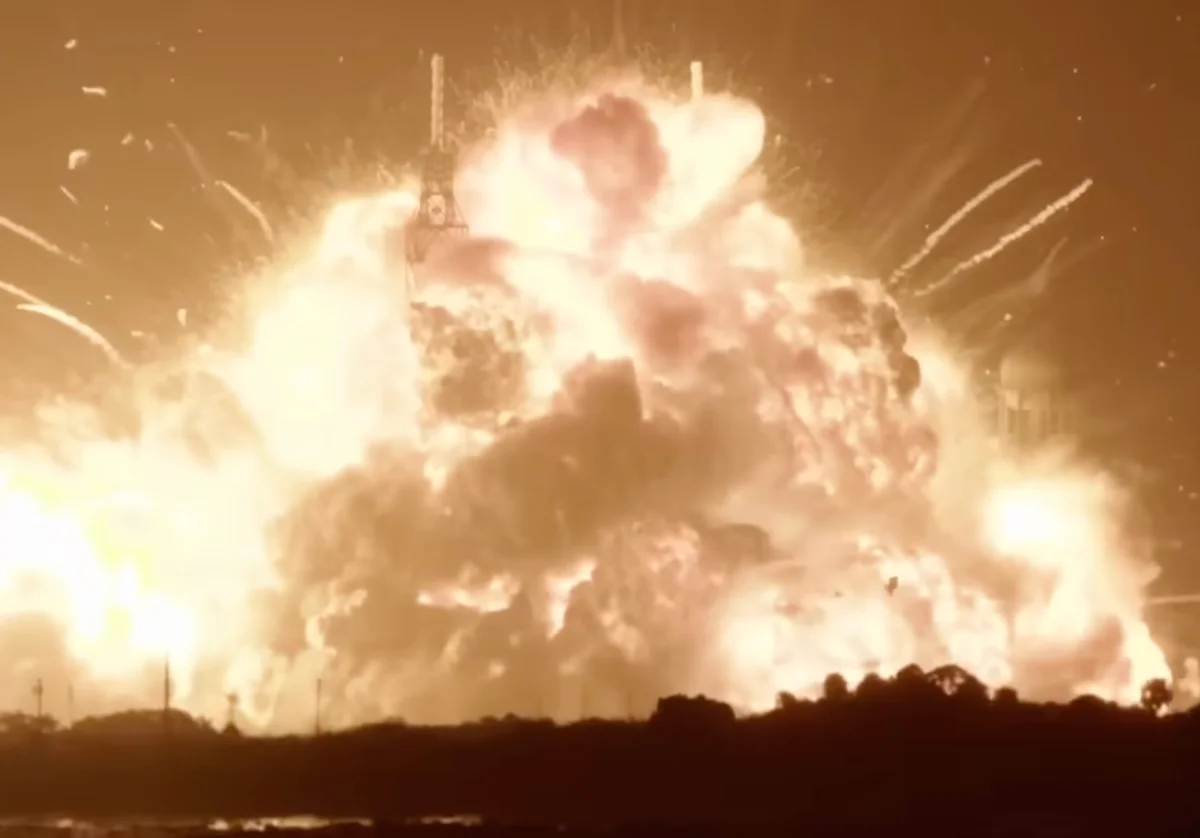
The landscape of commercial space exploration in the United States has suffered a historic upheaval. In what is already being considered the most destructive accident in the private aerospace industry, the Launch Complex 36 (LC-36) pad at Cape Canaveral Space Force Station became the scene of a massive detonation. The protagonist of the disaster was Blue Origin's imposing New Glenn heavy-lift vehicle—specifically the fourth mission vehicle (NG-4)—which experienced a catastrophic failure during a static fire test on the night of May 28, 2026. The total loss of the rocket, a behemoth measuring 98 meters tall and 7 meters in diameter, not only leaves a deep scar on the Florida coast but also immediately freezes the geopolitical and commercial aspirations that depended on its power.
The Physics of an Unprecedented Detonation
The static fire test is a mandatory but high-risk routine: the engines are fired at full power for a few seconds while the vehicle remains firmly anchored to the launch pad. At the time of the incident, the New Glenn's first stage was fully loaded with approximately 1,102,230 kilograms of a highly energetic combination of liquid oxygen and liquid methane. As the uncontrolled combustion unleashed, the thermodynamic release of energy was colossal. Interestingly, the flash of the fireball was visible to commercial pilots mid-flight over Orlando, 80 kilometers away, and even by ground observers on the opposite coast of Florida in the city of Tampa, located about 193 kilometers from the epicenter.
To understand the magnitude of the event, analysts are comparing this non-military pad explosion to the historic disaster of the Soviet N1 moon rocket at Baikonur in 1969. The resulting shockwave shook the foundations of homes in Titusville and Cocoa Beach. To put it into an everyday analogy, the amount of energy released instantly is equivalent to the simultaneous detonation of thousands of tons of dynamite, transforming a high-tech infrastructure into a veritable inferno of twisted metal in a fraction of a second.
Engineering Hypotheses Behind the Anomaly
While telemetry and high-speed camera footage are under strict analysis by Blue Origin and federal authorities, the aerospace engineering community is considering two main suspects. The first hypothesis points to the catastrophic rupture of a high-pressure helium tank located inside the upper stage's liquid oxygen tank. This scenario is identical to the one that destroyed a SpaceX Falcon 9 in 2016. Imagine a hyper-inflated balloon bursting inside a pool of reactive liquid: the pressure wave ruptures internal structures and immediately mixes the fuel with the oxidizer.
The second possibility centers on a critical anomaly in the turbopump of one of the seven BE-4 engines on the first stage. These engines operate on a sophisticated, oxygen-rich staged combustion cycle. Preliminary images show an unusual flare-up at the base of the rocket just as ignition began. The failure of a component spinning at high revolutions inside the turbopump—which acts like a race car's turbocharger pushed to the absolute edge of physics—could have projected metallic shrapnel at supersonic speeds, puncturing the adjacent methane tanks and causing the immediate structural collapse of the booster.
A Assessment of Critical Structural Damage
The damage to the LC-36 complex is massive and will require a long-term reconstruction effort, once again debunking the wild optimism of those who view space travel as easy or free of red tape. The enormous mechanical arm known as the Transporter-Erector, responsible for raising the rocket, was left completely charred and warped by the extreme heat. Additionally, one of the two colossal 183-meter-tall lightning towers collapsed due to the blast wave and the thermal weakening of its foundations. Even the Horizontal Integration Facility suffered structural damage, collaterally affecting the historic booster SN002, christened Never Tell Me the Odds, which was sheltered inside.
Given that the LC-36 pad is Blue Origin's only active orbital platform and that paperwork for a second facility is in its early regulatory stages, the company faces an insurmountable logistical bottleneck. Reconstructing the supply systems, helium lines, and certifying the new structures will take at least 12 to 18 months, grounding Jeff Bezos's company for the remainder of 2026 and much of 2027.
Artemis and Amazon Leo Against the Ropes
The impact of this disaster extends directly to the plans of NASA, led by its administrator Jared Isaacman. The ambitious Moon Base I mission, scheduled for this fall with the launch of the Blue Moon Mark 1 lunar lander, has been postponed indefinitely. Similarly, the VIPER robotic rover will suffer massive delays by losing its launch vehicle, and the development of the super-heavy New Glenn 9x4 variant, vital for the crewed Artemis IV and V lunar landings later this decade, will be severely slowed down.
On the other hand, Amazon's satellite internet network, commercially named Amazon Leo, faces an unprecedented regulatory compliance crisis. By FCC mandate, the company must have 1,618 satellites operational before July 30, 2026, or risk losing its spectrum rights. With barely 302 satellites in orbit at the end of May 2026, the goal is mathematically unattainable without New Glenn. Amazon's extension request faces fierce opposition from its rival SpaceX. Without operational rockets of its own, Amazon will have no choice but to exhaust the limited inventory of the Atlas V, turn to Ariane 6, or pay multimillion-dollar fees to its direct competitor to launch its payloads on Falcon 9 rockets, inadvertently cementing a total SpaceX monopoly on western high-frequency heavy-lift launches.
Related
Related news and articles
- 📰 The Strategic Shift Toward the Moon Base Reconfigures ESA's Alliances With NASA 15 JUN 2026
- 📰 The Sovereign Rebirth: How Europe Hacked the Space Crisis of 2026 4 MAY 2026
- 📰 ESCAPADE Prepares its Mars Trajectory Resumption After a Unique Orbital Loiter Phase 21 OCT 2026
- 📰 The Era of Interplanetary Alliances: The Aeolus Mission and NASA's New Paradigm on Mars 24 JUN 2026
Marspedia terms
- 📖 Methane
Enjoyed it? Keep exploring
Back to all news