
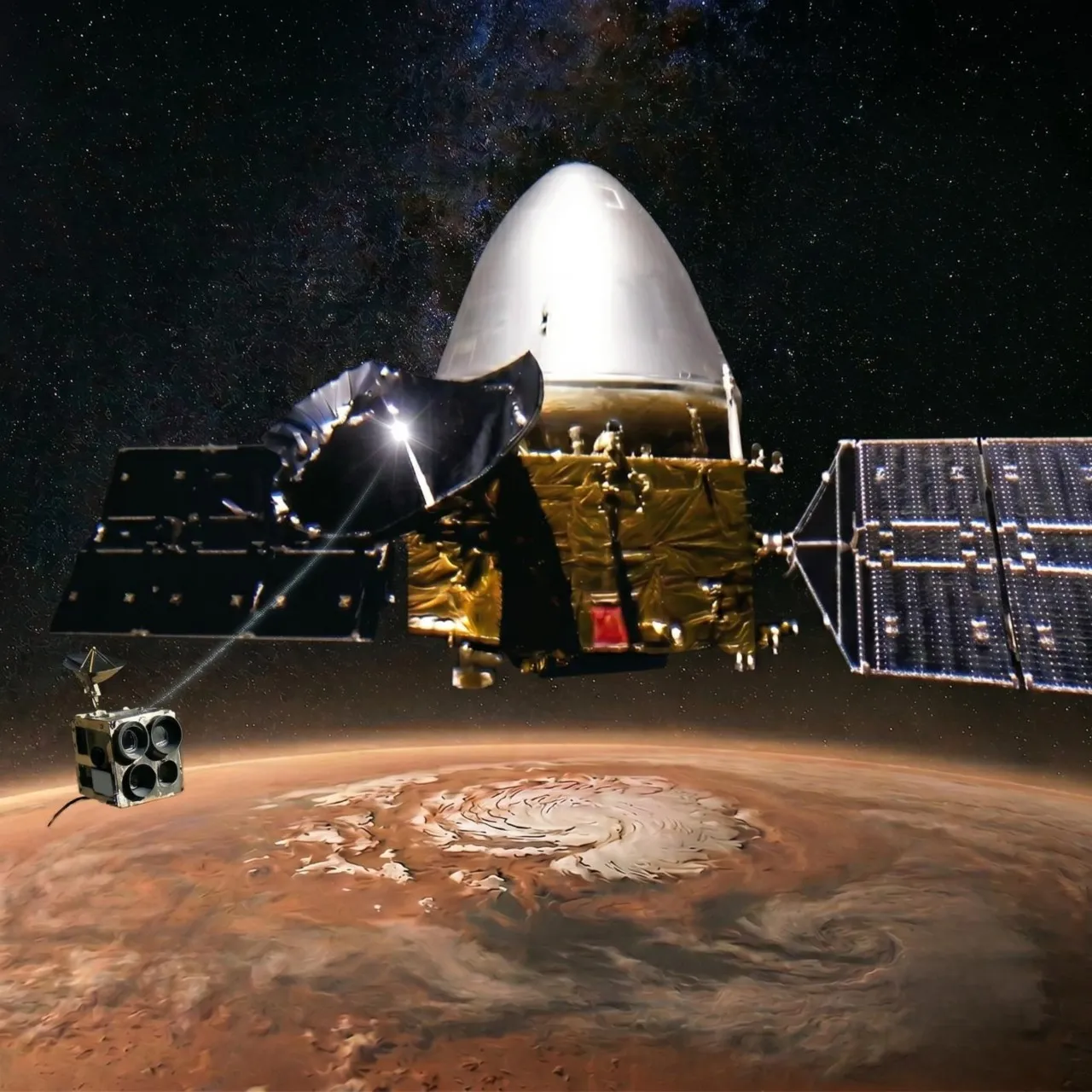
TDC-2 Tianwen-1
The ejectable microsatellite TDC-2 of the Tianwen-1 mission successfully validated passive visual diagnosis in Martian orbit on December 31, 2021. Utilizing a 180° dual-lens optical design and a short-range wireless system, it captured high-resolution images of the orbiter without active attitude control.
Agency

Country

Type
Orbiter
Status
Launch
July 23, 2020
COSPAR ID: 2020-040A
Official Names: Tianwen-1 (including the Orbiter and the Deployable Camera Subsystem TDC-1 and TDC-2)
Responsible Space Agency: China National Space Administration (CNSA)
Launch Date and Time: July 23, 2020, 04:41 UTC
Orbital Insertion Date and Time (Mars Arrival): February 10, 2021, 12:03 UTC
TDC-2 Ejection / Operation Date and Time: December 31, 2021, 16:30 UTC (approximate)
Launch Site: Wenchang Space Spacecraft Launch Site, Pad LC-101
Coordinates / Operational Location: Elliptical Martian orbit (TDC-2 operated in high orbit)
Launch Vehicle: Long March 5 (CZ-5 Y4)
Current Mission Status: Primary and extended missions successfully completed; orbiter in long-term observation / data relay mode.
1. Historical Context and Detailed Objectives
The Tianwen-1 mission was conceived as the inaugural step of China's independent planetary exploration, seeking to address the lack of direct and sovereign empirical data regarding the Martian surface and atmosphere. Historically, the external diagnosis of interplanetary spacecraft depended on internal sensors or complex robotic arms that increased dead mass. The technical gap lay in the external, global visual monitoring of the orbiter in deep space without the use of servomechanisms.
The primary objective of the overall mission was to achieve orbital insertion, descent, and the deployment of a surface vehicle in a single launch window. For the specific Deployable Camera (TDC) subsystem, the main objective was to perform an autonomous visual diagnosis of the orbiter's external structural status after orbital insertion and stabilization. The secondary objective was to validate technologies for sub-kilometric, passive, and ejectable optical registration microsatellites operating under severe thermal and radiation environments near the northern Martian polar cap.
2. Vehicle Architecture and Main Subsystems
The Tianwen-1 orbital platform had a total mass of approximately 5000 kg at launch, of which 3175 kg corresponded strictly to the orbiter. The TDC-2 subsystem was integrated as an ultra-low mass (sub-kilometric) free element. The main propulsion of the orbiter relied on a 3000 N liquid fuel engine, utilized for the 15-minute orbital insertion maneuvers, while the TDC-2 lacked active propulsion, relying on the mechanical energy of calibrated ejection springs for its separation.
The thermal control of the TDC-2 combined passive multi-layer insulation with an independently controlled active electric heater, maintaining the device within a safe storage range between -35 °C and 0 °C during eclipses and navigation within the orbiter's shadow. Power generation for the main orbiter was provided by sun-tracking solar arrays, whereas the TDC-2 depended on internal high-energy-density batteries with a lifespan limited to the free operational phase. Attitude control of the orbiter utilized high-precision star trackers and gyroscopes; conversely, the TDC-2 utilized passive stabilization via angular momentum transferred during ejection.
The main orbiter's telecommunications implemented an X-band system coupled to a high-gain antenna, communicating with the China Deep Space Network (CDSN) at distances exceeding 240 million kilometers. The TDC-2 subsystem utilized a short-range radio frequency transmitter integrated into its structure, transmitting digital image data frames via direct wireless signals to the orbiter at distances of a few hundred meters, with the latter acting as a relay node to Earth.
3. Payload and Scientific Instrumentation
The central instrument of the TDC-2 consisted of a redundant dual-lens imaging system based on a high-definition CMOS/CCD solid-state sensor. The physical operating principle is based on the photoelectric effect, where incident photons release electrons within the pixel matrix, generating an electrical charge proportional to the intensity of the sunlight reflected by the mother spacecraft and the planet Mars.
Anchoring analogy
Imagine throwing a small action camera with a timer out of the window of a moving vehicle to take a picture of the car itself as it moves away; the TDC-2 optical system performs this exact function, but in the vacuum of deep space and replacing the photographer's hands with a mechanical spring.
The detection range of the instrument was within the visible spectrum, optimized through a Modulation Transfer Function (MTF) of 0.3 at the sensor's Nyquist frequency of 67.6 lp/mm. Each of the two lenses, opposed at 180°, had a net mass of 8 grams. The manufacturer of the subsystem was the aerospace development academy affiliated with the CNSA, and its explicit purpose was to clearly resolve fine details of the orbiter's metallic structure, its solar arrays, and the high-gain antenna against the Martian disk.
4. Launch Vehicle and Flight / EDL Profile
The orbital and Martian transfer injection was performed by the Long March 5 heavy-lift rocket (CZ-5 Y4). Following separation from the launch vehicle, the spacecraft executed trajectory correction maneuvers (TCM) during the interplanetary cruise. Martian orbital insertion occurred on February 10, 2021, via the continuous firing of the 3000 N engine, reducing relative velocity to allow gravitational capture.
For the TDC-2 subsystem, the critical separation sequence took place on December 31, 2021, in a high Martian orbit. Previous random vibration tests on Earth qualified the structure to withstand the launch and insertion environment, applying a profile of 20 to 100 Hz (+3 dB/oct), a constant zone from 100 to 600 Hz (0.125 g²/Hz), and an attenuation from 600 to 2000 Hz (-9 dB/oct), resulting in an overall RMS acceleration of 10.13 g for 1 minute per axis. The spring-loaded separation mechanism limited the angular rotation speed to a predictable range, preventing kinematic blurring of the images captured by the optical sensor through adaptive exposure times.
5. Operational Development and Scientific Results
Following the orbital insertion of the main probe in February 2021, the orbiter stabilized its working trajectory. On December 31, 2021, after executing an active preheating strategy via the heater's hysteresis cycle to reach the nominal operating temperature of +15 °C (preventing the freezing of optical lubricants and battery degradation), the TDC-2 was released. The micro-device drifted away autonomously, transmitting real-time wireless data to the main orbiter.
Operational anomalies arising from the lack of active attitude control were mitigated by the dual-opposed lens configuration, which ensured that at least one optic kept the mother spacecraft within its angular field of view. Technical and scientific results included the confirmation of the optimal structural condition of the orbiter's solar panels and thermal blankets after a year of radiation exposure. Furthermore, the images processed on Earth by the China Deep Space Network (with range accuracies of 0.09 m) allowed for the clear observation of the full disk of Mars and the seasonal morphology of the northern polar cap, providing data on the distribution of carbon dioxide and water ice.
6. Conclusion and Technical Legacy
The operation of the TDC-2 validated a disruptive paradigm in deep space mission engineering: the use of passive, ejectable optical subsystems for self-diagnosis in place of heavy mechanical appendages. The mitigation of rotation through strict control of the ejection angular momentum and the redundant dual-optic design demonstrated that it is possible to obtain high-resolution metric imagery using disposable sub-kilometric platforms. Lessons regarding thermal balance management and proximity wireless links in hostile planetary environments establish design baselines for monitoring and visual support systems in future Martian sample return missions (Tianwen-3) and minor body exploration.
Mission Milestones
Launch
SOL 29 OF PHOBO OF YEAR 35
202 days (~196 sols)
of travel
Arrival at Mars
SOL 3 OF ACIDALO OF YEAR 36
Operations Start
SOL 21 OF LUNO OF YEAR 36