
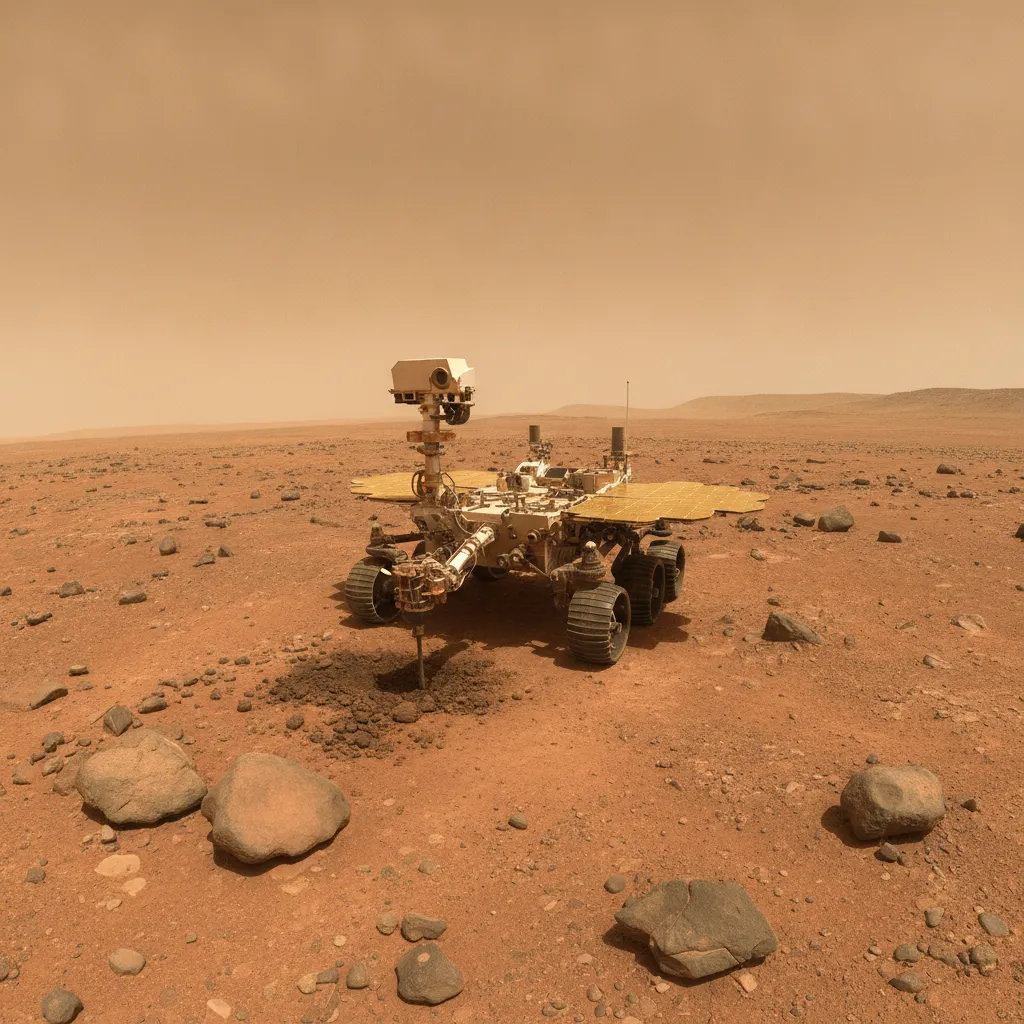


Technical Analysis of the ExoMars Rosalind Franklin Mission (EXM-RFM)
- Mission Designation: ExoMars Rosalind Franklin (EXM-RFM)
- Operating Agency: European Space Agency (ESA) and National Aeronautics and Space Administration (NASA)
- Launch Date: Late October 2028
- Launch Vehicle: Falcon Heavy (SpaceX)
- Launch Site: Launch Complex 39A (LC-39A), Kennedy Space Center, Florida
- Landing Site: Oxia Planum
- Total Mass (Rover): 310 kg
- Mission Status: Planned (In development / Phase C)
1. Mission Objectives
The scientific vacuum that the mission intends to fill focuses on the direct search for biomarkers and organic compounds in the Martian subsurface, avoiding degradation by ionizing radiation and surface oxidation. Primary and secondary objectives are structured into:
- Search for signs of past or present life on the surface and subsurface of Mars.
- Characterize the mineralogical and geochemical distribution of clay deposits in Oxia Planum.
- Study atmospheric composition and its interaction with the surface through the use of the ExoMars Trace Gas Orbiter (TGO) as a relay link.
- Drill to a depth of 2 meters to extract in-situ samples protected from extreme environmental conditions.
2. Probe and Subsystem Specifications
The Rosalind Franklin rover has a mass of 310 kg and approximate dimensions of 2 meters in height by 2.5 meters in width (reaching 3.5 x 2 x 2 meters if the descent platform assembly is included). The power system consists of solar panels capable of generating an estimated energy of around 1200 Wh per day, backed by an 1142 Wh lithium-ion battery. For thermal control in the Martian environment, it incorporates radioisotope heater units (RHUs) provided by NASA. Communications are managed through UHF and X-band links, employing the TGO orbiter as an intermediary satellite. Mobility is entrusted to a six-wheel system adapted for the autonomous exploration of complex terrain.
3. Payload and Scientific Instrumentation
The core of the astrobiological research rests on the Pasteur analytical package, which integrates the following instruments:
- PanCam (Panoramic Camera): Panoramic and high-resolution camera system for surface and atmospheric geological study.
- ISEM (Infrared Spectrometer for ExoMars): Infrared spectrometer intended for remote mineralogical characterization.
- WISDOM (Water Ice and Subsurface Deposit Observation on Mars): Subsurface sounding radar to map geology down to several meters depth.
- CLUPI (Close-Up Imager): High-resolution camera focused on detailed short-range rock inspection.
- RLS (Raman Laser Spectrometer): Raman laser spectrometer for the identification of organic compounds and minerals.
- MicrOmega: Visible and near-infrared microscope for the mineralogical analysis of microsamples.
- MOMA (Mars Organic Molecule Analyzer): Gas chromatograph and mass spectrometer for the search for complex organic molecules.
- Ma_MISS (Mars Multispectral Imager for Subsurface Studies): Spectrometer integrated into the drill itself to analyze the internal wall of the borehole.
4. Launch Vehicle
Transport outside the Earth's atmosphere is assigned to the Falcon Heavy heavy launcher, operated by SpaceX, lifting off from Launch Complex 39A (LC-39A) located at the Kennedy Space Center (Florida, United States).
5. Chronology and Mission Phases
The program has undergone various strategic and industrial restructurings:
- 2009-2016: Genesis of the ExoMars program under the tutelage of ESA and formalization of international cooperation agreements.
- March 19, 2022: Temporary suspension of cooperation with Roscosmos due to geopolitical factors, which froze the initially planned launch.
- March 2023: Formal reincorporation of NASA into the project and restructuring of the mission architecture to adapt it to the Falcon Heavy launcher.
- April 2026: Official approval of the project implementation by NASA.
- Late October 2028 (planned): Scheduled launch from the US cosmodrome.
- November 30, 2030 (planned): Insertion, descent, and landing maneuver in Oxia Planum.
6. Preliminary Results and Legacy
Being in a development phase prior to its launch, no in-situ scientific operations have been recorded. However, laboratory analyses with terrestrial analogues and tele-detected study of clay deposits in Oxia Planum have validated the instrumental robustness of the MOMA system and the pertinence of the selected site for the future extended or nominal mission phase estimated at at least 218 sols.