


COSPAR Designation: 2023-157A
Official Mission Name: Psyche (NASA's Mission to Asteroid 16 Psyche)
Responsible Space Agency: NASA (National Aeronautics and Space Administration) / Jet Propulsion Laboratory (JPL) / Arizona State University (ASU)
Launch Date and Time: October 13, 2023, 14:19 UTC
EDL / Maximum Approach Date and Time at Mars: May 15, 2026, 04:33 UTC (Approximate)
Geographic Location / Flyby Coordinates: Mars nightside hemisphere, minimum altitude of 4,609 kilometers above the surface
Launch Vehicle: SpaceX Falcon Heavy (Expendable/semi-reusable configuration)
Current Mission Status: Active, in interplanetary transit phase (Cruise 2) towards asteroid (16) Psyche after successfully completing the Mars gravity assist
1. Historical Context and Detailed Objectives
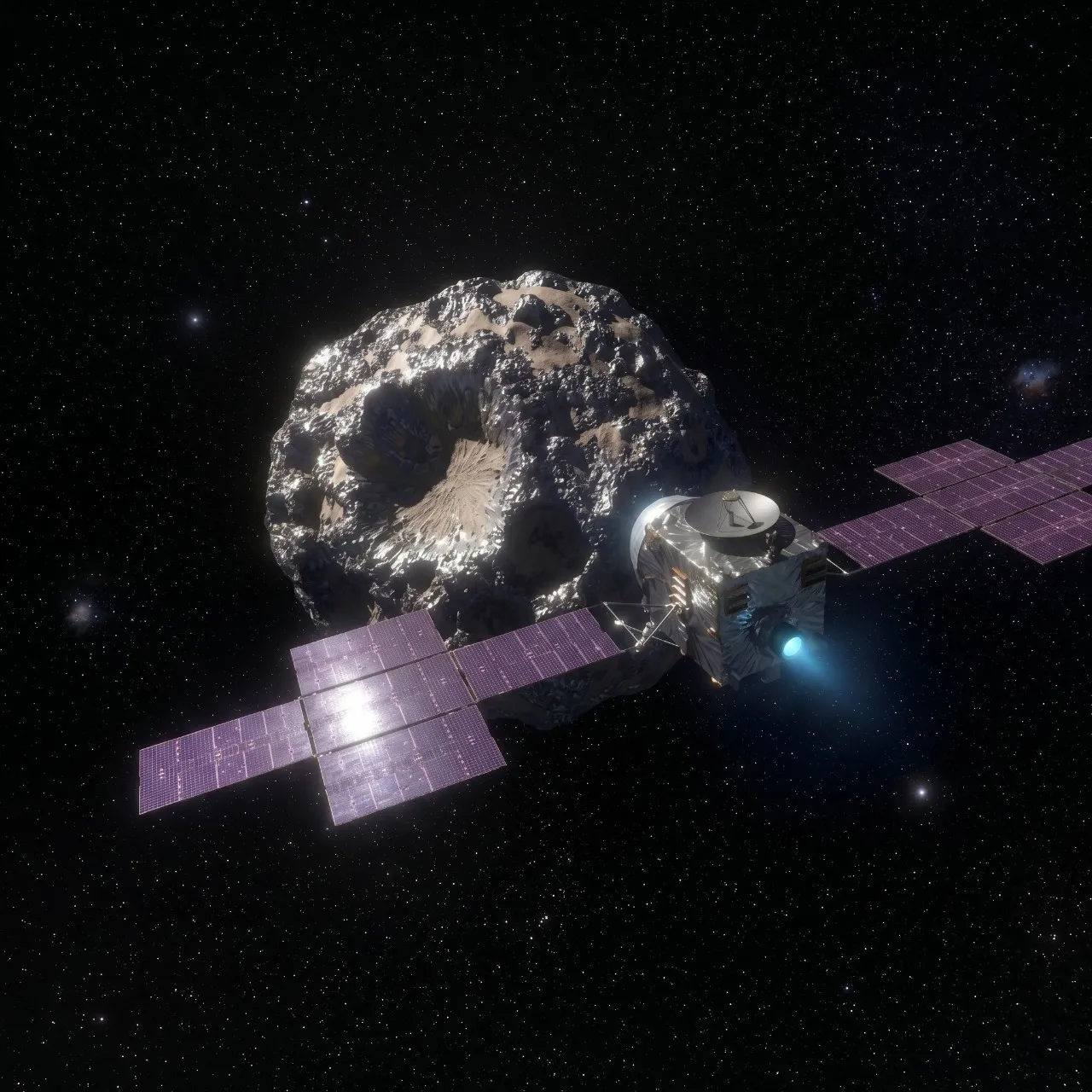
The Psyche mission was originally conceived to explore what is presumed to be the exposed metallic core of an ancient protoplanet, offering a unique window into early planetary differentiation in the solar system. However, mass constraints and orbital mechanics impose severe limits on direct travel to the main asteroid belt. The orbital plane of asteroid (16) Psyche presents an inclination of 3 degrees relative to the Earth's ecliptic. Modifying this trajectory in a purely propulsive manner would have required a prohibitive amount of xenon propellant, reducing the mass margin of the scientific payload.
To fill this scientific gap and optimize the low-thrust trajectory, navigation engineers planned a Mars gravity assist (MGA) maneuver. The primary objectives of the Martian encounter focused on transferring angular momentum from Mars' orbit to the interplanetary spacecraft to increase its heliocentric velocity and correct the orbital inclination by approximately 1 degree. Secondary objectives encompassed the in-flight calibration of scientific instruments using Mars as an exhaustively characterized reference body, optimizing processing algorithms prior to arrival at the final target.
2. Vehicle Architecture and Main Subsystems
The spacecraft is based on a modified Maxar 1300 series commercial chassis, optimized for deep space environments. It registers a total launch mass of approximately 2,608 kilograms. Power generation relies on two cross-shaped solar array wings totaling an area of 75 square meters, designed to provide more than 20 kilowatts in Earth's vicinity and decay predictably as the spacecraft moves away from the Sun.
Thermal control is critical due to the thermodynamic expansion of xenon within the solar electric propulsion (SEP) subsystem. Regulation valves undergo a severe temperature drop when expanding the gas from the 18.6 MPa stored in the titanium tanks down to the injection pressure level. To understand this cooling effect, imagine what happens when you press an aerosol deodorant can continuously; the container cools down rapidly in your hands due to the decompression of the gas inside. On the spacecraft, this phenomenon requires an active continuous thermal input of 1 watt to prevent structural failures from freezing within the distribution lines.
Attitude control is primarily managed via reaction wheels, complemented by an independent cold gas subsystem that stores 46 kilograms of pressurized nitrogen in three titanium tanks. Deep space telecommunications are structured around the Small Deep Space Transponder (SDST), which operates coherent links in X-band for essential telemetry and commanding, and Ka-band for high-volume science data downlinks. During the Martian flyby, the transmission rate was remotely configured to 61.1 kbps to optimize the download of stored engineering telemetry logs.
3. Payload and Scientific Instrumentation
The scientific payload of the Psyche spacecraft was strategically activated during the planetary encounter for operational validation:
Multispectral Imager
Consists of a pair of identical cameras equipped with telephoto lenses and spectral filter wheels. It operates on the physical principle of refracting reflected sunlight from the planetary surface at specific wavelengths to determine mineralogical composition. Its everyday analogy is the use of polarized sunglasses or photographic filters that highlight certain colors and landscape contrasts while eliminating unwanted glare. It covers the visible and near-infrared spectrum, manufactured by Malin Space Science Systems, with the purpose of mapping geology and topography.
Magnetometer
Composed of two highly sensitive magnetic sensors mounted on a 2-meter deployable boom. Its physical principle is based on magnetic induction to measure the intensity and direction of local magnetic fields. It operates similarly to the digital compass of a smartphone, but with a sensitivity thousands of times higher, calibrated to ignore the electromagnetic field generated by the spacecraft itself. It features a wide dynamic range designed to detect remanent planetary crustal fields, manufactured by the University of California, Los Angeles (UCLA).
Gamma-Ray and Neutron Spectrometer (GRNS)
This instrument detects secondary particle emissions from the ground when it is bombarded by cosmic rays. Its physical principle relies on a cryogenically cooled high-purity germanium (HPGe) semiconductor crystal. The anchoring analogy corresponds to a game of billiards where the cue ball (cosmic rays) hits the grouped balls (atoms in the soil), causing them to scatter in predictable trajectories and energies that reveal their physical identity. It detects neutron flux and high-energy gamma photons, manufactured by the Johns Hopkins University Applied Physics Laboratory (APL) to quantify chemical elements in the regolith.
Deep Space Optical Communications (DSOC)
An experimental technology demonstration subsystem for laser communications. Its principle is the emission of modulated infrared light pulses at 1550.12 nanometers via a master oscillator power amplifier configuration. It is equivalent to transmitting complex messages in Morse code using a high-power laser pointer with millimeter precision toward a distant receiver. It transmits broadband data from interplanetary distances using pulse-position modulation (PPM), developed by the Jet Propulsion Laboratory (JPL).
4. Launch Vehicle and Flight / EDL Profile
The launch was successfully executed from Kennedy Space Center using a Falcon Heavy launch vehicle. Following injection into the interplanetary transfer orbit, the mission divided its flight profile into rigorous operational phases. The Cruise 1 phase comprised the continuous firing of the SPT-140 Hall-effect thrusters to gradually accelerate the spacecraft in a heliocentric spiral trajectory.
Exactly 60 days prior to the Mars encounter, the Gravity Assist phase commenced. During this interval, the spacecraft's ion thrusters were completely shut down to enter a passive coasting navigation regime. This absolute deactivation of propulsion was mandatory for Earth-based navigators to model the trajectory with millimeter precision through the Martian B-plane, preventing small thrust variations from interfering with the flyby's gravitational modeling. The hyperbolic approach occurred on May 15, 2026, crossing the Martian periapsis at an altitude of 4,609 kilometers and a relative speed of 21,000 kilometers per hour. Since the spacecraft is not designed for atmospheric entry, it did not execute an Entry, Descenst, and Landing (EDL) sequence, cleanly passing through the gravitational well to deflect its heliocentric trajectory and gain 447 meters per second of net velocity.
5. Operational Progress and Scientific Results
During interplanetary transit, the flight team overcame a critical anomaly on April 1, 2025, within the primary xenon distribution line, where pressure unexpectedly dropped from 248 kPa to 179 kPa due to a partial mechanical seizure of the proportional flow control valve. The issue was definitively mitigated in May 2025 via a command reconfiguration that transitioned operations to an identical secondary backup line, commanding it to remain permanently open and transferring flow regulation exclusively to the thrusters' cathode flow controllers.
The Martian flyby on May 15, 2026, provided high-value scientific data for instrument calibration. The multispectral imagers captured thousands of images at high phase angles. On the illuminated limb, a noticeable attenuation of light scattering was detected over the winter northern polar cap, interpreted as dense seasonal carbon dioxide clouds blocking the underlying atmospheric dust scattering signature. After periapsis, the instrument captured the southern polar cap at a resolution of 1.14 kilometers per pixel. Meanwhile, the GRNS measured the occultation shadowing effect and secondary neutron interactions with the Martian atmosphere, allowing the scientific team to contrast background data with consolidated models from the Curiosity rover, successfully resolving thermal drifts within the germanium crystal channels.
6. Conclusion and Technical Legacy
The successful execution of the Psyche spacecraft's Mars gravity assist validates the feasibility of complex interplanetary mission designs that rely on low-thrust solar electric propulsion combined with high-precision passive maneuvers. The timely resolution of the anomaly within the xenon distribution system demonstrates the resilience of the spacecraft platform architecture and the critical importance of hardware redundancy in deep space missions.
The instrument calibration methodologies applied during the hyperbolic flyby set a rigorous technical precedent for characterizing sensors during cruise phases. With the flight subsystems stabilized and calibrated against a well-known planetary body, the spacecraft continues on an optimal trajectory toward its definitive orbital insertion at asteroid Psyche scheduled for August 2029, consolidating the use of modified commercial telecom platforms for frontier solar system science.
Related
Missions
- 🛰️ Curiosity
Related news and articles
Events
- 📅 Launch of Psyche 13 OCT 2023 · 14:19 UTC · SOL 24 OF HESPERO OF YEAR 37
- 📅 Mars Arrival of Psyche 15 MAY 2026 · 04:33 UTC · SOL 14 OF OLYMPO OF YEAR 38
- 📅 End of mission: Psyche 17 MAY 2026 · 00:00 UTC · SOL 16 OF OLYMPO OF YEAR 38