
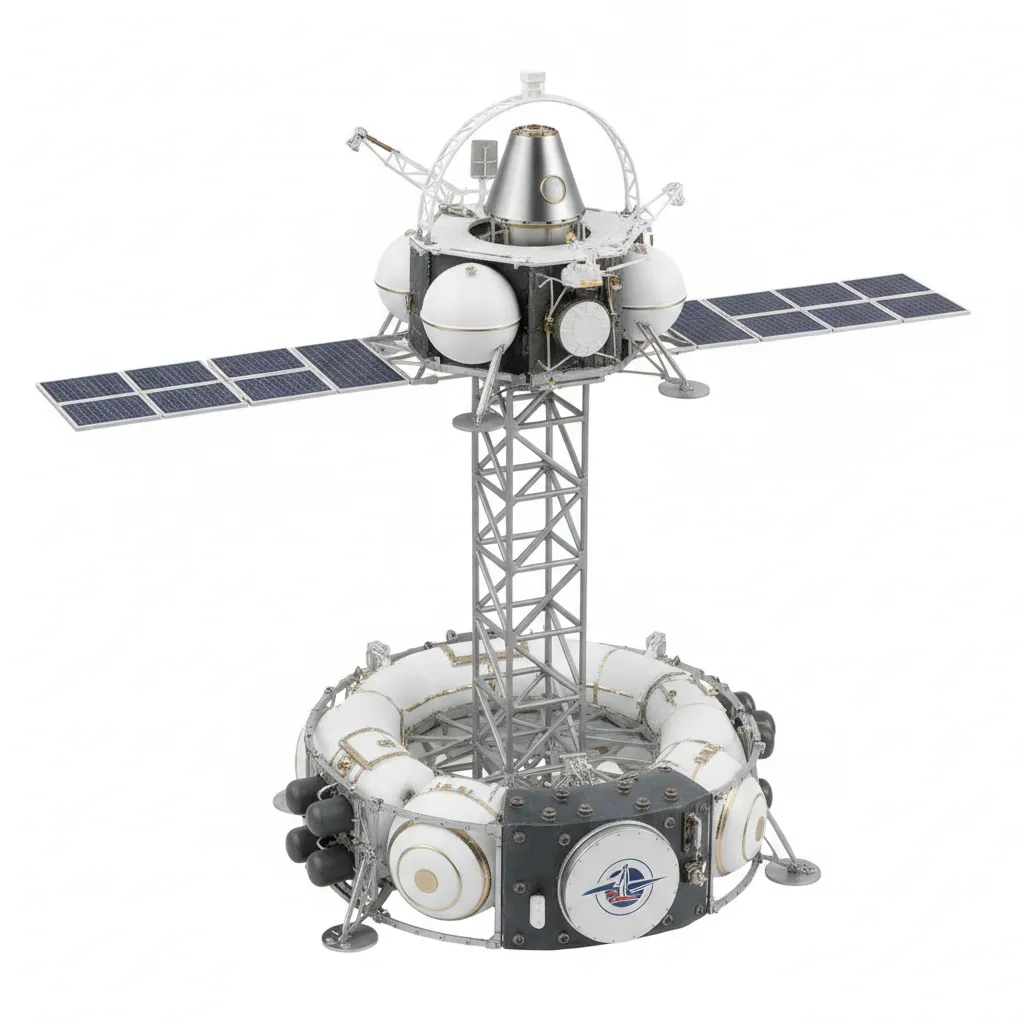


Technical Analysis of the Phobos-Grunt Mission
- Mission Designation: Phobos-Grunt (Fobos-Grunt / Фобос-Грунт)
- Operating Agency: Roscosmos (Russia), with participation from CNSA and the Planetary Society
- Launch Date: November 8, 2011 (20:16:02 UTC)
- Launch Vehicle: Zenit-2SB41.1
- Launch Site: Baikonur Cosmodrome, Pad 45/1, Kazakhstan
- Mission Status: Complete Mission (Failed)
1. Historical Context and Detailed Objectives
The scientific gap that the Phobos-Grunt mission intended to fill encompassed the in-situ study and recovery of pristine material from a Martian satellite. The mission architecture combined an orbiter module, a Phobos lander module, and an Earth return capsule. The primary objectives focused on:
Engineering:
- Validate the interplanetary transport system and propulsion capabilities of the Russian platform for sample return missions.
- Demonstrate autonomous landing and robotic operations on a low-gravity body such as Phobos.
- Successfully deploy the secondary orbiter Yinghuo-1 contributed by CNSA.
Scientific:
- Collect approximately 200 grams of regolith soil from the surface of Phobos.
- Return the samples to Earth using an armored descent capsule.
- Study the molecular and mineralogical composition of Phobos and perform remote observations of Mars.
2. Spacecraft Specifications and Subsystems
The launch mass of Phobos-Grunt was 13,505 kg, of which 11,000 kg corresponded to propellant, with an estimated dry mass between 2,300 kg and 2,450 kg. The structure was organized modularly into a cruise module, a main propulsion stage (MDU), a lander module, and a return vehicle (VA) with its descent capsule (SA). The main power system supplied 1 kW to the orbiter and lander, and 300 W to the return vehicle. Following the launch failure, the probe became trapped in a low Earth orbit (LEO) with an initial apogee of 342 km and a perigee of 207 km, an inclination of 51.43°, and an orbital period of 90.0 minutes.
3. Payload and Scientific Instrumentation
The scientific instrumentation installed for the analysis of Phobos and Mars included the following devices:
- GAP: Spectrometer for the analysis of the molecular composition of the soil.
- MDGF: Gamma-ray spectrometer for surface geochemical study.
- MAIN: Neutron spectrometer for the detection of hydrogen and volatiles.
- Lazma: Time-of-flight mass spectrometer.
- MANAGA: Complementary mass spectrometer.
- THERMOFOB: Thermal probe for surface property studies.
- RLR: Subsurface radar for internal mapping.
Additionally, the payload integrated the Chinese Yinghuo-1 orbiter (with dimensions of 0.75 m × 0.75 m × 0.60 m and a solar wingspan of 7.85 m) and the LIFE biological experiment from the Planetary Society.
4. Launch Vehicle
The launch was executed using a Zenit-2SB41.1 carrier rocket from the Baikonur Cosmodrome (Pad 45/1) in Kazakhstan, initially inserting the spacecraft into a low Earth parking orbit prior to the escape sequence toward Mars.
5. Timeline and Mission Phases
- November 8, 2011: Successful launch to low Earth orbit at 20:16:02 UTC.
- November 2011: Critical failure of the onboard computers upon failing to ignite the trans-Mars injection engines, attributed to the combined impact of cosmic radiation and deficiencies in electronic components.
- November 24, 2011: Last intermittent contact with the probe.
- January 15, 2012: Uncontrolled destructive reentry into Earth's atmosphere at 17:46 UTC, with debris dispersion over the Pacific Ocean (Bellingshausen Sea, near the coast of Wellington Island).
6. Results and Technical Conclusion
Due to the permanent blockage of the spacecraft in low Earth orbit and the impossibility of executing the escape burns, none of the interplanetary phases were completed nor were scientific data obtained from Phobos or Mars. The mission resulted in a total scientific loss of the primary payload and concluded prematurely.
Related
Missions
- 🛰️ Yinghuo-1
Events
- 📅 Launch of Phobos-Grunt 8 NOV 2011 · 20:16 UTC · SOL 19 OF BOREO OF YEAR 31
- 📅 End of mission: Phobos-Grunt 15 JAN 2012 · 17:46 UTC · SOL 11 OF DEIMO OF YEAR 31