

Technical Analysis of the Mars 7 Mission
- Mission Designation: Mars 7
- Internal Designation (USSR): 3MP No.51P
- Operating Agency: Ministry of General Machine Building (MOM) / NPO Lavochkin
- Launch Date: August 9, 1973, 17:00:17 UTC
- Launch Vehicle: Proton-K / Blok D (8K82K)
- Launch Site: Baikonur Cosmodrome, Site 81/24
- Status: Mission Failure (Unintended Flyby)
1. Mission Objectives
Mars 7 was the final spacecraft of the 1973 Soviet armada, a twin to Mars 6. Its mission was the most complex of the launch window:
Engineering and Operations:
- Transport a lander module to the vicinity of Mars.
- Execute the separation of the module and perform a direct atmospheric entry for a soft landing.
- The flyby module (Bus) was to continue its trajectory to serve as a communications link with Earth.
Scientific:
- Study the composition of the Martian atmosphere and surface in situ.
- Measure physical parameters during descent (pressure, temperature, density).
- Analyze the plasma and radiation environment in interplanetary space and near Mars.
2. Spacecraft Specifications (3MP Platform)
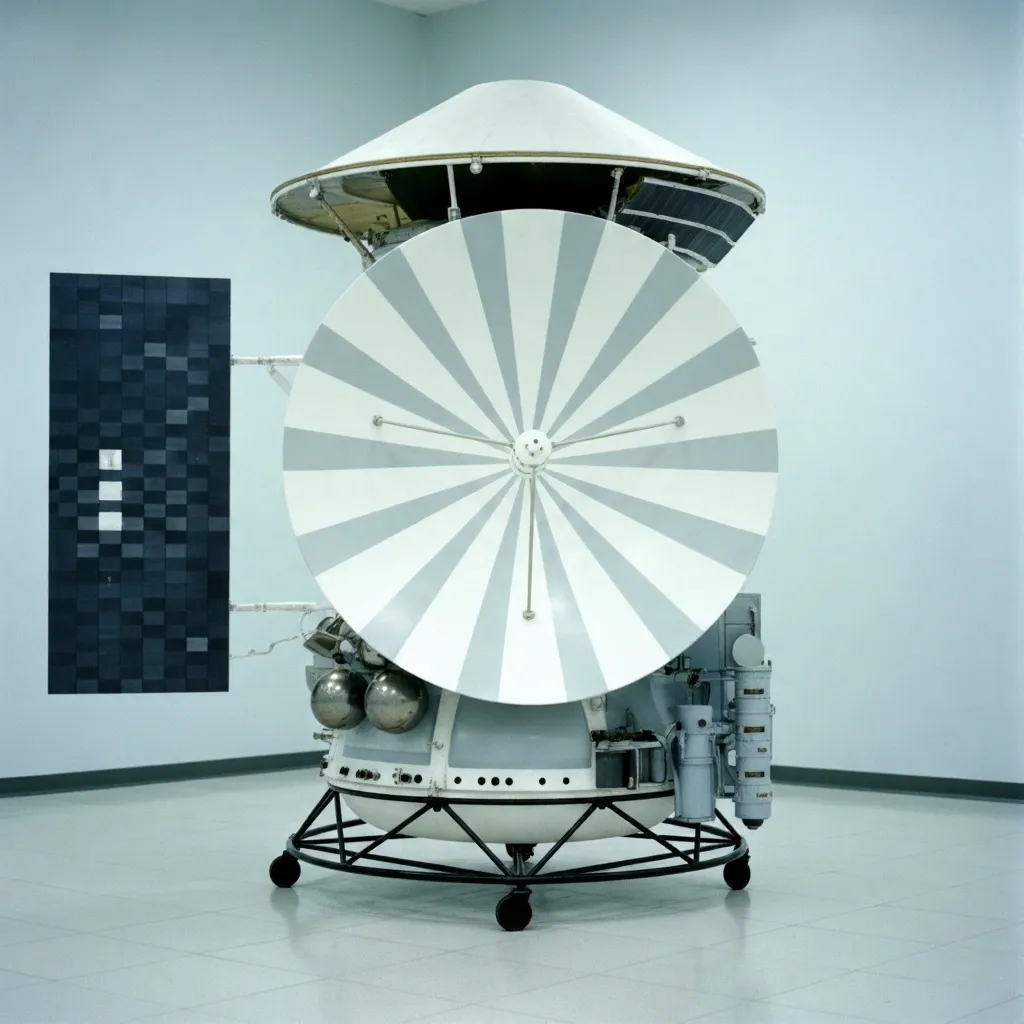
The spacecraft utilized the 3MP configuration, optimized to carry a descent vehicle instead of fuel for orbital insertion.
- Launch Mass: 3,260 kg (Some sources cite higher figures including upper stages, but the standard 3MP probe mass is ~3.2t).
- Dimensions: Cylindrical bus ~2.8 m in height with two extendable solar panels.
- Lander Module: Spherical capsule of ~635 kg (similar to Mars 6) equipped with an aerodynamic heat shield and multi-stage parachute system.
- Propulsion: KTDU-425A main engine for mid-course corrections and nitrogen gas thrusters for attitude control.
3. Scientific Instrumentation
The payload was distributed between the cruise vehicle and the lander:
Flyby Bus (Coast Stage):
- Magnetometer: To study the planetary magnetic field.
- Plasma Traps and Cosmic Ray Detectors: To monitor solar wind and radiation.
- Micrometeoroid Detector: To measure interplanetary dust flux.
- Lyman-Alpha Photometer: To detect hydrogen in the upper atmosphere (cited in general series configurations).
Lander Module:
- Mass Spectrometer: For chemical analysis of the atmosphere.
- Environmental Sensors: Thermometer and barometer for surface conditions.
- Radio Altimeter and Accelerometer: Critical instruments for descent control.
4. Failure Analysis
The Mars 7 mission suffered a disappointing fate due to systemic failures in Soviet electronics of the era.
- Arrival at Mars: The spacecraft reached the vicinity of Mars on March 9, 1974, three days before its twin Mars 6 (launched earlier but on a different trajectory).
- The Separation Failure: Due to a malfunction in the onboard computer (likely corrosion in the chips or an error in the attitude control/retrorocket system), the lander separated prematurely or failed to execute the final correction maneuver necessary to intercept the atmosphere.
- Trajectory Result: Instead of entering the atmosphere, the lander flew past the planet at a minimum distance of 1,300 km from the surface.
- Root Cause: Subsequent investigations identified the use of transistors with aluminum components instead of gold, which corroded rapidly, as the primary cause of control system failure across the entire Mars M-73 series.
5. Technical Conclusion
Mars 7 was a total failure regarding its surface objectives. The inability to correct its trajectory or properly time the lander separation resulted in both the bus and the lander entering a permanent heliocentric orbit. This failure, combined with the problems of Mars 4, 5, and 6, marked the end of the Mars M-73 probe series and forced a complete re-evaluation of space electronics manufacturing standards in the Soviet Union.
Related
Events
- 📅 Launch of Mars 7 9 AUG 1973 · 17:00 UTC · SOL 17 OF NILO OF YEAR 10
- 📅 Mars 7 Launch 9 AUG 1973 · 17:00 UTC · SOL 17 OF NILO OF YEAR 10
- 📅 Arrival and Failure of Mars 7 9 MAR 1974 · 12:00 UTC · SOL 37 OF ACIDALIO OF YEAR 11