
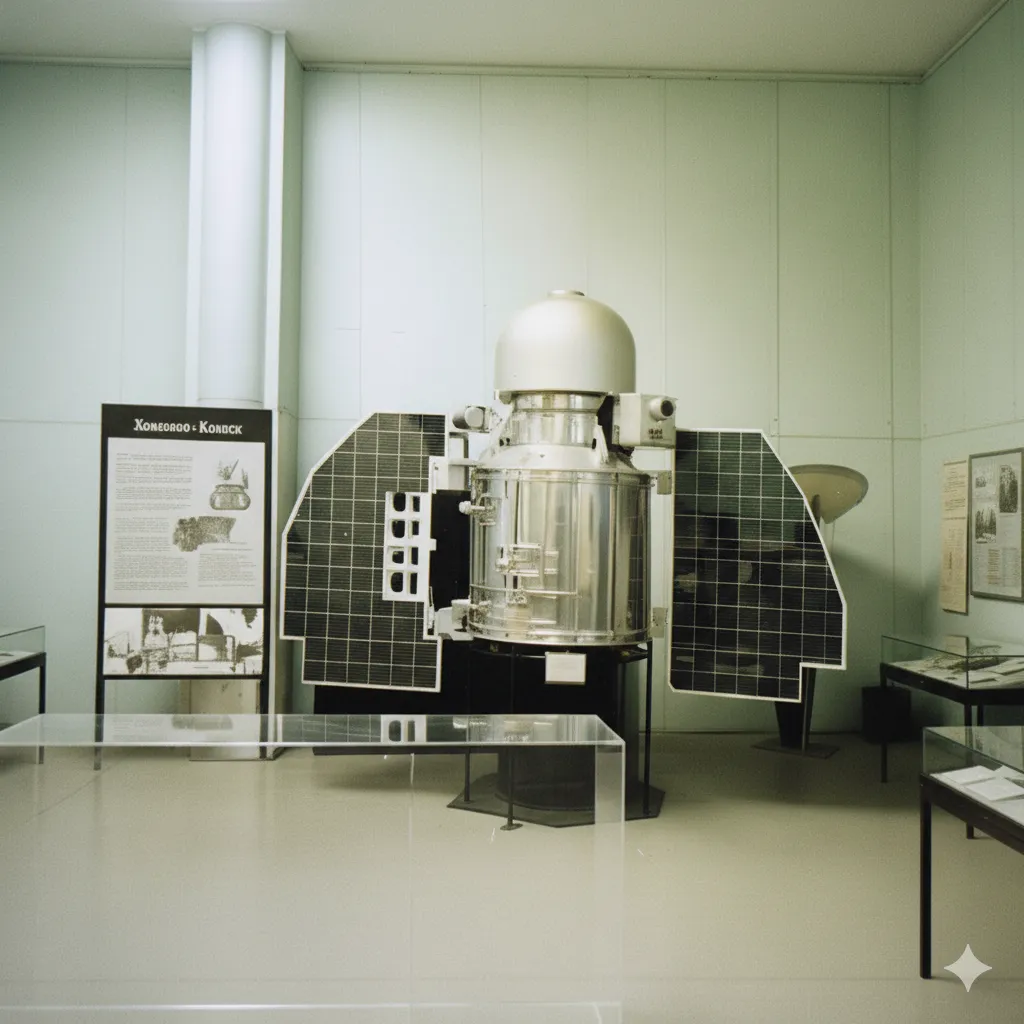
Mars 1M No.1 (Korabl 4)
The Korabl 4 (1M No. 1) mission represented humanity's first attempt at an interplanetary flyby toward Mars in 1960. A mechanical failure caused by hydraulic cavitation in the Molniya rocket's third-stage turbopumps broke the horizon gyroscope, resulting in a suborbital ballistic reentry over Siberia.
Agency

Country

Type
Flyby
Status
Launch
October 10, 1960
COSPAR ID: 1960-F02 (Unofficial / Launch failure)
Official Name: Korabl 4 / 1M No. 1
Western Informal Names: Marsnik 1 / Mars 1960A
Responsible Space Agency: Soviet Union Space Program / Experimental Design Bureau 1 (OKB-1)
Launch Date and Time: October 10, 1960 at 14:27:49 UTC
EDL Date and Time: Not applicable (Third stage failure at T+309 seconds)
Launch Site: Baikonur Cosmodrome, Site 1/5, Kazakh SSR
Suborbital Impact Coordinates: Debris disintegrated in the atmosphere and fell over Eastern Siberia, Russian Federation
Launch Vehicle: Molniya 8K78 (Serial number L1-4M)
Current Mission Status: Destroyed / Launch failure
1. Historical Context and Detailed Objectives
The Korabl 4 mission was conceived at the height of the space race, a period of geopolitical confrontation where the demonstration of technological capability served as a direct substitute for military power. Under the direction of Sergei Korolev at OKB-1, and authorized by a government decree in January 1960, the Soviet Union sought to exploit the autumn planetary launch window of that year. The purpose was to consolidate the advantage gained from the previous successes of the Sputnik satellites and the Luna probes, anticipating any United States initiative toward the inner solar system.
The scientific void that this mission intended to fill was absolute. In 1960, knowledge about Mars depended exclusively on ground-based telescopic observation, which was limited by the distortion of Earth's atmosphere. Deep uncertainties existed regarding the actual density, pressure, and composition of the Martian atmosphere, as well as the presence of a planetary magnetic field or trapped radiation belts analogous to Earth's Van Allen belts. The primary objectives of the mission were to perform the first interplanetary flyby of Mars, photograph its surface from a close trajectory, and analyze its atmospheric environment. Secondary objectives focused on the study of the deep interplanetary medium, measuring the solar wind, cosmic rays, and micrometeorite density in the space between the orbits of Earth and Mars.
2. Spacecraft Architecture and Primary Subsystems
The 1M No. 1 probe featured a total launch mass of 650 kilograms in its fueled configuration, which was reduced to a dry mass of approximately 480 kilograms following last-minute modifications. Its primary structure consisted of a central hermetic and pressurized cylindrical container, with a height of 2.0 meters and a diameter of 1.0 meter. To ensure the viability of the electronic components, this internal compartment housed dry nitrogen stabilized at a constant pressure of 1.2 atmospheres. Internal thermal control relied on an active loop of mechanical fans that forced gas circulation to dissipate waste heat from the equipment, maintaining the nominal temperature at around 30 degrees Celsius.
The electrical power generation system depended on two symmetrical solar panels with a combined total surface area of 2.0 square meters. These panels continuously fed a central high-energy-density silver-zinc battery. The orientation of the photovoltaic cells required an active three-axis attitude control subsystem, which operated using optical solar and stellar tracking sensors designed to lock their position relative to the Sun and the star Canopus. Yaw, pitch, and roll corrections were executed through micro-nozzles that expelled cold nitrogen gas.
For main propulsion and interplanetary trajectory correction maneuvers (TCM), the probe incorporated the KDU-414 engine developed by Isayev's OKB-2. This thrust unit utilized a hypergolic system composed of inhibited red fuming nitric acid (IRFNA) as oxidizer and unsymmetrical dimethylhydrazine (UDMH) as fuel, with a total propellant mass of 35 kilograms. The engine operated at a chamber pressure of 1.18 megapascals, generating a vacuum thrust of 1.96 kilonewtons with a specific impulse of 272 seconds. The telecommunications system integrated a high-gain parabolic antenna constructed with a flexible copper mesh of 2.33 meters in diameter for transmitting telemetry in the decimetric band, along with a transmitter in the 8-centimeter wavelength band dedicated to sending scientific data. The expected bit rate in the vicinity of Mars was extremely low due to the technological limitations of the era, requiring several hours to transmit a single frame of engineering data.
3. Payload and Scientific Instrumentation
Ultraviolet spectrograph
The mission of this optical instrument was to determine the chemical composition of the upper Martian atmosphere by detecting the emission and absorption lines of gases interacting with solar radiation. Its physical principle was based on the dispersion of light through a diffraction grating.
As an anchoring analogy, this process is equivalent to how a glass prism breaks down white light into a rainbow; by observing which colors are missing or brighter, one can identify the elements that compose the gas passed through. The sensor monitored the far-ultraviolet range, developed by the Institute of Applied Geophysics of the USSR Academy of Sciences, with the purpose of searching for gaseous signatures of nitrogen and oxygen.
Fluxgate triaxial magnetometer
Designed to measure the intensity and direction of the interplanetary and Martian magnetic field across three orthogonal axes. It operated via conductive coils excited by alternating currents that altered the magnetic permeability of an internal ferrous core.
Its operation is similar to that of underground metal loops that detect the presence of a car stopped over the asphalt at a traffic light by altering their electrical environment. Manufactured by the Institute of Terrestrial Magnetism, Ionosphere and Radio Wave Propagation (IZMIRAN), it possessed a highly sensitive detection range calibrated in nanoteslas.
Plasma ion trap
An electrostatic sensor responsible for quantifying the density and temperature of the low-energy charged particle flux originating from the solar wind. It used a series of metallic grids charged with specific voltages to filter and collect incident ions.
This works analogously to a kitchen sieve that retains particles of a certain size and lets the rest pass through, measuring in this case the electrical current generated by the impact of the captured ions. Developed by the Radio Engineering Institute of the Academy of Sciences, its purpose was to map the boundary of the Martian magnetosphere.
Cosmic ray counter and ionizing radiation detector
A set of Geiger-Müller tubes and scintillation counters intended to measure the flux of high-energy particles in interplanetary space. The passage of charged subatomic particles caused instant ionization of the internal gas or light flashes in a sensitive crystal.
It is comparable to an access turnstile that counts one by one the passage of pedestrians crossing a barrier. Designed by the Institute of Nuclear Physics at Moscow State University, this system aimed to assess lethal radiation levels for future crewed missions.
Micrometeorite impact detector
A piezoelectric device coupled to the structural plates of the probe to register the frequency and kinetic energy of cosmic dust impacts. The physical clash of a particle generated an electrical pulse proportional to the force of the impact.
The mechanism resembles the operation of a microphone recording the patter of raindrops on a tin roof. Manufactured by OKB-1, its goal was to quantify the hazard of environmental erosion along interplanetary trajectories.
4. Launch Vehicle and Flight / EDL Profile
The flight profile required an accumulated dynamic budget of approximately 11 kilometers per second to achieve trans-Martian injection (TMI). The four-stage Molniya 8K78 rocket was utilized for this purpose. The vector possessed a staged propulsion configuration: the first stage consisted of four lateral conical boosters (Blocks B, V, G, and D) with RD-107 engines, surrounding the second central stage (Block A) equipped with an RD-108 engine. Both stages operated on liquid oxygen (LOX) and RG-1 type kerosene. Following the separation of the lateral boosters at T+119 seconds, Block A continued the ascent until T+301 seconds, at which point the third stage (Block I) was scheduled to ignite, propelled by an RD-0107 engine using LOX and T-1 type kerosene. The nominal plan required Block I to insert the assembly into a stable Earth parking orbit, from which the fourth stage (Block L) would ignite synchronously to initiate the heliocentric escape toward Mars.
The mission suffered a catastrophic failure during the ascent phase of the third stage. During the operation of the lower stages, degraded aeroelastic behavior was generated due to hydraulic instability within the feed system of the third-stage RD-0107 engine. The lack of adequate hydrodynamic pressure at the turbopump suction reduced the Net Positive Suction Head Available margin below design requirements, triggering a severe cavitation phenomenon.
Cavitation involved the violent formation and implosion of vapor bubbles inside the turbopumps, releasing mechanical micro-shockwaves. This induced fluctuations in the propellant mass flow and cyclic thrust oscillations within the combustion chambers. These high-frequency vibrations were transmitted through the fuselage and entered into harmonic resonance with the structure of the upper instrument compartment. At T+300.9 seconds, the cyclic mechanical loads fractured the physical contact of the pitch potentiometer inside the horizon gyroscope of the I-100 inertial guidance system. With the feedback loop broken, the autopilot lost its angular pitch reference. At T+309 seconds, the launch vehicle having deviated by a critical angle of 7 degrees from the programmed trajectory, the onboard computer commanded an emergency engine shutdown. The vehicle reached a suborbital apogee of 120 kilometers before performing a controlled, non-destructive ballistic reentry into the atmosphere, disintegrating due to thermal friction over Eastern Siberia at 4,800 kilometers from the launch site.
5. Operational History and Scientific Results
Due to the structural failure of the launch vehicle barely five minutes after liftoff, the Korabl 4 probe never reached Earth orbit nor was it able to begin its interplanetary operational phase. As a direct consequence of this premature anomaly, no scientific data regarding the Martian atmosphere, geomagnetic measurements of its environment, or photographic records of its surface were obtained. The onboard scientific instruments, whose combined mass was only 10 kilograms following the removal of the primary phototelevision system for weight reasons a week prior to launch, functioned solely by transmitting internal diagnostic telemetry during the brief suborbital ascent phase.
The only empirical return from the operation was technological in nature and restricted to the engineering telemetry of the Molniya carrier rocket. Data from accelerometers and pressure sensors confirmed empirically the presence of flow instabilities coupled with the elastic structure of the rocket. These logs allowed for the first verification of the effects of extreme cavitation in real flight environments and its capacity to induce catastrophic material fatigue failures in critical electronic inertial guidance components.
6. Conclusion and Technical Legacy
The technical legacy of the Korabl 4 mission was fundamental for the development of systems engineering in deep space exploration. The detailed analysis of the cavitation failure mechanism forced the Chemical Automation Design Bureau (KBKhA) to completely redesign the suction lines, inductors, and turbopump impellers to guarantee a homogenous propellant mass flow under high acceleration conditions. The modifications applied to the unstable RD-0107 engine led to the development of the optimized RD-0108 and, subsequently, the RD-0110 variants.
This derivative engine became the third-stage powerplant for the Voskhod and Soyuz vector family, consolidating itself as one of the most stable liquid propulsion systems in aerospace history with hundreds of successful missions in Earth orbits and interplanetary trajectories. Likewise, the failure of the I-100 system's inertial interface prompted the introduction of vibration isolation and elastic damping methodologies for all gyroscopic sensors in subsequent probes of the Venera and Mars programs, transforming ground hardware qualification standards prior to flight.
Mission Milestones
Launch
SOL 24 OF UTOPO OF YEAR 3